Articles

Bodegas Fariña, DO Toro

BODEGAS FARIÑA, DO TORO

CHATEAU MOUTON ROTHSCHILD IT’S NOT

– I’M DELIGHTED TO SAY!

When visiting Bordeaux a few years ago our friend arranged a couple of Châteaux visits. He knew that I am involved in the wine world and that Claire used to teach English to several of the Directors of a number of the Châteaux. We were both very keen – the more so when we learned that one of the Châteaux was the world famous and super-elite Mouton Rothschild!

I felt sorry for our host, the visit was dreadful. It’s not the wine that I didn’t like – of course! It was the nature of the visit.

Our guide was pretty in looks, and pretty hopeless in guiding! Clearly she had no real idea about wine – oh yes, she’d read and learned the guiding manual and regurgitated it efficiently for our small group. But that was it! There was no back-up knowledge, no ability to answer sensible questions, no real interest and certainly no passion (for wine, I mean!).

What an amazing contrast I’ve just experienced at the family owned Bodegas Fariña, founding winery of DO Toro! I’ve never had a better wine tour and it’s unlikely I ever will!

I have to admit that ours perhaps wasn’t the norm – for a start our ‘guide’ was Nicola (from Sheffield, but we forgave her!) who is in fact the Export Director of the company and travels the globe, promoting Fariña wines, of course, but also the whole DO Toro. She really should be on the Consejo Regulador’s payroll!

Another example of why ours was probably not the regular wine tourism visit (though I’m certain that this is excellent too!) was also Nicola related. We met her at the winery at 11:00 hrs where she jumped onto our coach and took us to the vineyards. She left us at about midnight at the last of the bars which forms the DO Toro Ruta del Vino! Now that is well above the call of duty! Thirteen hours – amazing, and really appreciated!

I first met Nicola when I was part of a triumvirate running the CB Wine Club. She was then working for another DO Toro winery and similarly enthusiastic about their wines too – that’s the nature of this enterprising young lady! It wasn’t long before she was headhunted, by the Fariña family where I guess she has now been for about 15 years.

Our first wine, tasted in almost freezing temperatures, which in fact none of us minded, so warming was Nicola’s presentation and passion, was a sparkling wine – a surprise to me. Aromatic with some yeasty notes and a floral tone running throughout, it’s made with Malvasia, as is the Fariña still white wine. A good start.

FIZZ; TORO ETC; ROSANNA 025

 She told us of the family’s influence on wine making in the area and of how Señort Fariña single-handedly convinced the powers that be in Madrid to grant the area Denominación de Origen status. DO Toro was now on the Spanish wine map – and after consistent success, particularly in the export market (no surprise there, as Nicola has clearly made a huge impact), the Fariña name became established.

This success made others believe they could do the same and there are now several bodegas making top class wine – including the equal most expensive wine in Spain! Rags to riches, or what? And it couldn’t have happened if it wasn’t for the Fariña family.

So, does that mean that Fariña wines are scarily expensive? Not a bit of it – the mantra here is value for money, always, from flagship to entry level, an excellent price/quality ratio.

For example, back at the bodega, where a large tasting room had been prepared for us, we were all knocked out by the pretty colour, the loganberry aroma and strawberry/raspberry flavour of the Colegiata Rosado – disbelieving, at first, it’s modest 4€ only price tag!

We tasted all the Fariña wines (that’s a large portfolio and there won’t be space to include them all here) – six or so at a relatively formal tasting and the rest over a magnificent, traditional lunch. Of course, we each had our favourites, but there wasn’t one that was disappointing.

FIZZ; TORO ETC; ROSANNA 030

 The much loved variety in DO Toro is Tinta de Toro (aka Tempranillo). The soils and micro-climate of Toro are so different from La Rioja, which many think of as Tempranillo’s natural home, that we could all be forgiven for thinking it a different variety altogether.

Many years ago the name of the variety that had adapted so well to Toro was not known – so, the pragmatic locals called it simply ‘Tinta de Toro’, not realising that it was actually Tempranillo. The name stuck.

The grape produced here is almost unrecognisable from that produced from the same variety in Rioja and indeed in other areas of Spain. It’s smaller with a thicker skin, thus the red Toro wines are very dark in colour. At night there is a dramatic drop in temperature during the growing season, causing the berries to dilate and contract which changes the aromatic profile.

Primero is a young wine – it’s the first wine to be produced by the bodega each year, and like Beaujolais Nouveaux its arrival on the shelves is trumpeted far and wine. However, unlike most Beaujolais Nouveaux, this is a quality wine! Also, on the label it proudly displays a reproduction of the winning entry in the annual Abstract Art Competition. Carbonic Maceration makes this wine typically fruit driven.

FIZZ; TORO ETC; ROSANNA 029

 Priced at just 4€ the Colegiata Tinta de Toro is all dark berry on the nose and palate with some lovely violet aromas and delightful liquorice twist on the finish. Gran Colegiata Roble has some oak as this wine is also used to ‘seal’ new oak barrels ready for making the top wines in the following year. It’s a win-win-wine situation as this partially aged wine gains a rich and fruity depth whilst preparing the barrels for the finer wine to come!

At lunch, the flagship wines were served – the Gran Colegiata Reserva 2008 priced at an amazing value for money 12€; and for me, the wine I most love from this excellent bodega, Gran Colegiata Campus! Some might think that at 22€ this is an expensive wine, but I assure you, if this wine was made in another, supposedly more illustrious area, it would probably command twice the price! It’s top class!

FIZZ; TORO ETC; ROSANNA 038

 You’ll be able to read more about Bodegas Fariña and the wines I haven’t had the space to mention at www.bodegasfarina.com . You’ll also be able to buy! You can also read a little more about DO Toro and its part in Columbus’ discovery of the Americas on my blog – www.colinharknessonwine.com click Blog.

Contact Colin: colin@colinharknessonwine.com and via Twitter @colinonwine. Also don’t forget to view Colin’s Youtube videos: www.youtube.com search Colin Harkness On Wine!

Dolce Divas Concert – the Wines!

WINES FOR DOLCE DIVAS CONCERT

It’s quite an honour to be asked to recommend and source the wines for a Classical Music Concert. I’m grateful for the opportunity to do so, provided by the Javea International Baptist Church for their Easter Concert, featuring the beautiful music of the equally beautiful Dolce Divas!

However, I’ll admit, it wasn’t a difficult task! Firstly I knew I would soon be travelling to Bodegas Fariña, DO Toro (more on this superb visit soon!) where I would surely be able to find either a red or a rosado of suitable quality.

Secondly, I’d also be visiting DO Rueda and considering that every 3·6 bottles (don’t you love statistics!?) of white wine sold in Spain comes from this amazing rags to riches area of production, it was clear that there would a plethora of white wines from which to choose.

And of course there was always my good friends at Bodegas Castaño, DO Yecla, who, although they sell 97% of their wines abroad, still keep some for the domestic market. As I said, easy job!

Sauvignon Blanc is considered to be a French variety, it makes the wonderful Sancerre and Pouilly-Fumé wines in Loire Valley. However the success of wines from these areas seemingly gave Sauvignon Blanc itchy feet. It travelled all over the world, and as we know it made more than a significant mark in New Zealand, from whence now hails, some would argue, the world’s best Sauvignon.

Let’s remember that Sauvignon’s passport has many stamps – one of which is from Spain, and in particular, the wine growing area to the north-west of Madrid, DO Rueda. Here, Sauvignon competes for vineyard space with the curiously similar (in some respects) local indigenous variety, Verdejo. And, as you’ve read here in Cork Talk, one of the bodegas in the vanguard of quality Rueda wine making using Verdejo is Palacio de Bornos.

They don’t do a bad Sauvignon, either! So it was this Bornos Sauvignon 2014 that I selected for the white wine offering (pun intended – offering, church, get it?!). Judging by the post concert comments, I think I got it right! Palacios de Bornos Sauvignon has all the classic characteristics of the Sauvignon that everyone wants to drink these days.

Highly perfumed: look for gooseberries, a touch of nettle and asparagus with some slightly under-ripe kiwi fruit (those New Zealanders again!) and a passing nod to fennel, it’s a super fruit driven, clean and refreshing dry white wine. If it’s not in your fridge already – do something about it, now! Well, immediately after you’ve read the rest of this column, at least!

Bodegas Fariña’s Rosado 2014 is made with their Tinta de Toro grape variety – though regular Cork Talk readers will know that this is really indicative of their   homage to Spain’s most grown and loved variety, Tempranillo – as it’s the same grape by another name. A grape by any other name, would smell as sweet? Well, no, William, it’s not sweet, actually!

In the glass the wine has presence – it’s not a shrinking violet and it’s not the pallid pink that seems to be de rigeur these days. Darkly coloured, it’s a wine in the classic Spanish rosado category. I’ve often said that Spain champions rosé wine better than any other country. Known, primarily as a red wine country (though this is definie tly changing), it’s only natural that winemakers of the past would have also made rosado wines.

It’s a tradition that still holds sway. Look at any Spanish wine shop and supermarket and you’ll see lots of rosé wines for sale. It’s a difficult choice, so let me help a little. For example, Bodegas Fariña, a family owned and run winery in DO Toro, has an enviable reputation as a producer of top quality red wines, with a very fair pricing structure too.

Their Colegiata Rosado 2014 is a lovely, bright cherry colour and looks beautiful in the glass. Swirl and sniff and you’ll find lots of soft red fruit aromas, the primary one for me is loganberry – raspberry, with attitude! There’s a lurking strawberry presence as well as redcurrant and cherry that follow through onto the palate too.

The red wine I chose, was in fact that which I chose for my recent wedding – to the lovely Claire! Hécula, from Bodegas Castaño is the wine that put the bodega, and indeed DO Yecla on the world wine map! Sold at an incredible value for money 6 – 7€, Hécula received over 90 points for Americna wine guru, Rober Parker, the first time he tasted it – and it has consistenty in the early 90s since.

It’s made with Monastrell, the favoured variety of South East Spain, which, although exhibiting slightly different aroma and flavour profiles depending on where it’s grown – i.e. DOs Valencia, Alicante, Yecla, Bullas, Almansa and Jumilla – invariably produces super-juicy, fruit driven wine.

Monastrell (known as Mourvedre in France) is also happy to spend time in oak, which when judiciously handled adds an extra depth of flavour, of course, and complexity too – but always retaining the fruit presence. Hécula has had six months in French oak and the balance is, well, perfect, making it a lovely wine for drinking on its own as well as with food, light and dark meats as well as cheeses.

The JIBC (www.javeabaptist.com) members provided an excellent ‘Bring and Share’ tapas choice for post concert drinks and bites and I was delighted to receive positive wine comments on behalf of the bodegas above. Plus, it was a real pleasure to hear the praise heaped upon Dolce Divas (www.dolcedivas.net) for an excellent concert whilst the stars were also enjoying a glass (or two!) of wine!

Contact Colin: colin@colinharknessonwine.com and through his website www.colinharknessonwine.com and via Twitter @colinonwine.

Colin is also posting videos on Spanish wine – please see and hear more at www.youtube.com search Colin Harkness On Wine.

Annual Blevins Franks Wine Tasting

ANNUAL BLEVINS FRANKS WINE TASTING

@ DENIA MARRIOTT


Unfortunately I’ve never been in a position which required me to seek the assistance of a Financial Services company. If you have no money, you can’t invest it! However, if a small fortune ever did come my way (some hope!) there’s no doubt that I’d contact Blevins Franks, straight away.


I’m sure that their financial advice is excellent (indeed, I’ve heard nothing but praise) but, as you might imagine, it’s their annual wine tastings which attract my attention! A few years ago I was invited (by friends who remain clients of Blevins franks) to attend one of their tastings, their second, I believe, presented by my friend and colleague, Ed Adams MW (Master of Wine).


Ed is not only a Master of Wine, one of just over 300 MWs in the entire world, but he also puts his knowledge to practical use, by making wine up in the hills of Cataluña – and top wines they are too, excellent! I was impressed with the tasting and wondered if I’d ever be able to attend another.


You can imagine my delight when, a couple of years ago I was invited to present a tasting for clients of the Blevins Franks Office in Alfaz del Pi; and even more so when in March 2015 I was invited to do the same, this time in the plush Marriott Hotel.


Essentially the choice of wines was left to me. There was a budget of course, though this wasn’t restrictive at all – with the most expensive wine priced at around the 35€ mark! It was also a most generous tasting for their invitees – eight wines were listed, with a final, mystery wine to finish. Then any wine left over was to be consumed in the nearby Jazz Bar, with tapas to boot!


We started with Sparkling Wine (and this after the Sparkling wine aperitif, welcome drink!). The idea was to have wines served in pairs, with a view to giving tasters the opportunity to compare wines within the same category. With the aperitif fizz being a young, bright and refreshing Brut (like the paired wines to follow, coming from the Albet i Noya Bodega, Penedés), I thought it apt to taste their Reserva Brut alongside their Pinot Noir Rosado.

 ALBET RESERVA brut

Clearly there’s an obvious comparison, one is white and the other rosé – but the contrast went deeper than that, of course. The Brut  (approx 11€) has had the benefit of 18 months ‘en rima’, that’s stored upside-down with its lees (the dead yeast that was added to provoke the second fermentation). This is twice as long as the minimum allowed in the nearby DO Cava (please note that, although made largely by the same method, Albet i Noya sparklers are not Cava – regular readers will know something of the history of this), and 18 months is three more than the minimum allowed for Cava Reservas.


The wine is full bodied with depth of flavour and super, aged fizz aromas – and a long finish.


The Pinot Noir (approx 15€) has had 12 months ‘en rima’. This traditional Champagne grape variety also adds a flavour of its own. There are loganberry notes, with some strawberry too and again a depth of flavour complemented by some complexity.

 ALBET ROSÉ pnrosat

The white wine pairing was one that I was looking forward to – I love the full range of Palacio de Bornos wines from DO Rueda, so it was difficult to choose! I went for the straight Verdejo 2014 (approx 5€), the wine that really made the bodega’s name, along with its elder sister the Verdejo Fermented en Barrica (approx 8€).

 Bornos Verdejo

The comparison here was the same grape variety, but treated differently. The former was stainless steel fermented allowing the glorious fruit to be at the forefront in terms of aroma and flavour; and the latter, that same fruit but with the integrated, yet still noticeable, beneficial influence of the oak barrels in which it had been fermented and aged. Both excellent!


For the rosado wines I wanted to give the tasters an opportunity to taste, perhaps the best rosé wine in Spain – the darkly coloured Gran Caus Merlot! The contrast here was two fold – the other rosado is made with Bobal, indigenous to Valencia, but also made in such a way that the very pale pink, almost onion-skin coloured, rosé makes it a very different animal, in looks alone!


The delicate perfume of the Pasión de Bobal Rosado (approx 6€) suggested a delicate flavour on the palate, but rather than being a touch weak in taste, in comparison to the meaty Merlot, I’d prefer to term it elegant – and certainly the personification of prettiness in the glass.  The Gran Caus has such a depth of flavour and oh so long finish, some might term it a wannabe red. This is rosé excellence (retailing at around 15€ so quite a lot more expensive than most, but trust me – it’s well worth it!).

 THAI WINE TASTING PASION ROSADOgran-caus-rosado

I used a Bobal again for the first red – and from the same Bodegas Sierra Norte, DO Utiel-Requena. Deeply coloured with dark cherries emanating from the glass the moment it is poured, it too has elegance as well as the dynamism of youth. The comparison wine was wholly different. Elevated to the impressive position of a very close second wine (if not its equal) to Bodega’s Castaño’s superb Casa Cisca flagship, this second red is really excellent!


Casa de la Cera (approximately 35€) has Monastrell at its heart (50%) with Garnacha Tintorera, Syrah, Cabernet Sauvignon and Merlot making up the rest of the blend. I love it!

 CASTAÑO casa_cera

The mystery wine was also made with Monastrell and also by Bodegas Castaño, DO Yecla. However, the mystery is that this wine is a ‘late harvest’. The grapes for such a wine are left on the vine for much longer than those destined to become dry wines. Harvested in November, the grapes look more like raisons. Some of the water content of the juice has been evaporated leaving less juice, but with a higher sugar content as the increased sunshine has over-ripened the grapes.


Dulce Monastrell Bodegas Castaño (approx 16€ for a 50cl bottle) is then aged for 6 months in French oak. The result is, well stunning! It’s a wonderful red dessert wine which is also happy with strong/blue cheeses – there is sweetness, yes, but like all the best dessert wines, there is also the necessary acidity to keep the wine fresh and alive. Excellent!

 Castaño dulce_sin_anada

PS I have 10 places only left for the super Bodegas Castaño Dinner and Concert at the Swiss Hotel Friday 8th May. The Castaño wines have been selected to be paired with the super four-course Swiss Hotel dinner; and the beautiful music will be performed by the equally beautiful Dolce Divas (www.dolcedivas.net). If you would like to secure some of the last few places, please contact me asap! Please call 629 388 159 or e-mail colin@colinharknessonwine.com


PPS please remember to regularly visit www.colinharknessonwine.com where you’ll see the Events Page, the Blog etc. Also you’ll be able to see and hear my comments on various wines by weekly visits to www.youtube.com – search Colin Harkness On Wine.

Rioja! Finca de los Arandinos

Restaurant, Finca de los Aranadinos - Boutique Hotel in the heart of La Rioja!
Restaurant, Finca de los Aranadinos – Boutique Hotel in the heart of La Rioja!

BODEGAS FINCA DE LOS ARANDINOS

DOCa. RIOJA

BODEGAS FINCA DE LOS ARANDINOS

DOCa. RIOJA

I first heard of Bodegas Finca de los Arandinos when I read an article by Sarah Jane Evans MW (Master of Wine), in the UK’s best wine magazine, Decanter. The essence of the article was that Sara Jane, Joint Chair of the Spanish Wine Panel of the magazine, was recommending 25 different Rioja wines that are currently on the shelves in UK wine shops.

I was delighted to see that I concurred with her views on several of the wines, as well as to see that there were wines listed that I did not know. I’ll be contacting a number of the bodegas concerned to find out more, and there was one that particularly caught my eye! A wine that hails from a bodega which also has a boutique hotel. Don’t you love wine research!

Finca de los Arandinos is an interesting new project. A new bodega, with modern buildings and state-of-the-art technology, but with more than a passing nod to tradition. It is perhaps correct to say that this bodega is at the forefront of ‘new age Rioja’. And this also means wine tourism.

The modernist boutique hotel is a delight to behold from the outside and from within. Indeed, the design inside, particularly in the bedrooms, is the work of the renowned designer David Delfin.

The wine that my colleague, Sara Jane Evans MW, included in her list of 25 was Malacapa 2013. It’s a ‘Joven’ wine, a young wine, with minimal (for Rioja) oak ageing and therefore wholly consistent with the bodega’s stated aims of bringing out the very best of each of the varieties used at Finca de los Arandinos.

FINCA ARANDINOS  malacapa_300x500

 95% of the blend is Rioja’s darling variety, now Spain’s most planted grape, Tempranillo, with just 5% Mazuelo thrown in too. Is this the most fruit orientated Rioja on the market? Well, if it’s not, it suerly is close!

On the nose there are both dark and red cherries which follow through onto the palate where, on the finish they are joined by a light liquorice flavour. But the most noticeable note with this wine is its juicy, chewy freshness – for lovers of pure fruit in wine, this has to be a top choice. (4€! incredible value from the on-line shop!!).

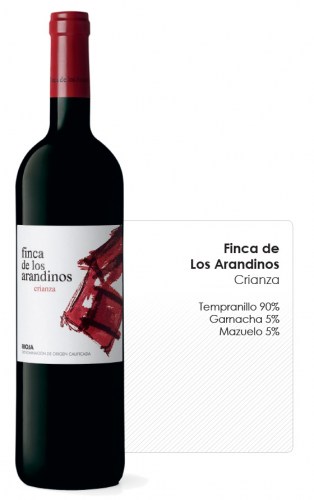
I mentioned that the winery is also aware of the great tradition that is Rioja and their Crianza pays homage to that history. Finca de los Arandinos 2011 Crianza, is everything that you would expect  – from a quality Crianza.

FINCA ARANDINOS crianza_300x500

 Many readers will know that a Crianza Rioja wine must have had a minimum of 12 months in oak (that’s twice the legal minimum for Spain) though many bodegas, in the past, at least, have considerably exceeded this minimum. Indeed, this wine has had more than the minimum time in oak, but only an extra month! So, another indication that this bodega, whilst following tradition, is intent on making sure that it’s the grapes’ juice, its fruit content that is to the fore.

Again the lion’s share is Tempranillo, but there is also 5% each of Mazuelo and Garnacha. Grapes are carefully selected in the vineyard and a blend is made from different plots. Once fermented ageing is 80% in French oak with 20% in American oak. The resultant wine is fruit first with extra depth of flavour and complexity added by the judicial use of oak. If you like a good Rioja Crianza, this is most definitely for you. (8€)

The final red wine, so far – there may be plans in the future to add to the portfolio – is called El Conjuro. It’s a limited production wine that has been given some red carpet treatment. The 2010 is made with Tempranillo again but this time Garnacha has a more prominent 15% of the blend. Fermentation takes place in French oak ‘foudres’ and it’s French oak in which malolactic fermentation takes please with a further 16 months ageing.

FINCA ARANDINOS conjuro_300x500

 But the wine is not ready for release yet. It stays in bottle in the depths of the cellar for a further year until the winemaker believes it is perfect for sale. However, that does not mean that it has be drunk immediately. El Conjuro has time on it’s – the 2010, tasted in early 2015, has a slight tannic grip still, indicating that there is still time for it do develop further.

It’s all about dark fruits, black cherries and blackberries, with earthy notes too, on the nose. In the mouth it is intense at first, opening up to be a subtle and elegant wine with a longer finish, leaving the taster more than satisfied with its lasting flavour and aroma. (14€)

I was pleased to see also, that Bodegas finca de los Arandinos makes a white wine as well. Eschewing the offer of the ‘new’ varieties now permitted in DOCa Rioja, this wine is made exclusively with old vineyard Viura, which has had the benefit of some time in oak. Indeed foudres are employed for its fermentation, after which is was put in French oak barrels for a further ten months, with regular ‘battonage’, stirring, with its lees.

FINCA ARANDINOS BLANCO

 The result is a dry white wine with some floral notes on the nose, a touch of citrus and an endearing, if slightly understated, creaminess. (6€)

NB These wines can be bought on-line www.fincadelosarandinos.com, please note prices above.

So that’s some of the Finca de los Arandinos information – but, why take my word for it? You can join me, October, 26th – 30th, 2015, when I am taking a small group (24 max) to stay at their boutique hotel! For more details please contact me and visit my website.

Contact Colin: colin@colinharknessonwine.com and via www.colinharknessonwine.com as well as via Twitter @colinonwine. Please also note that you can view Colin’s wine videos www.youtube.com search Colin Harkness On Wine.