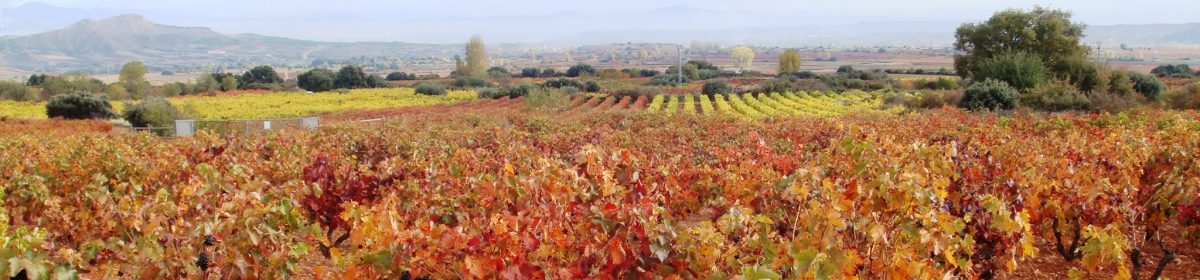
Rioja! Finca de los Arandinos

Restaurant, Finca de los Aranadinos - Boutique Hotel in the heart of La Rioja!
Restaurant, Finca de los Aranadinos – Boutique Hotel in the heart of La Rioja!

BODEGAS FINCA DE LOS ARANDINOS

DOCa. RIOJA

BODEGAS FINCA DE LOS ARANDINOS

DOCa. RIOJA

I first heard of Bodegas Finca de los Arandinos when I read an article by Sarah Jane Evans MW (Master of Wine), in the UK’s best wine magazine, Decanter. The essence of the article was that Sara Jane, Joint Chair of the Spanish Wine Panel of the magazine, was recommending 25 different Rioja wines that are currently on the shelves in UK wine shops.

I was delighted to see that I concurred with her views on several of the wines, as well as to see that there were wines listed that I did not know. I’ll be contacting a number of the bodegas concerned to find out more, and there was one that particularly caught my eye! A wine that hails from a bodega which also has a boutique hotel. Don’t you love wine research!

Finca de los Arandinos is an interesting new project. A new bodega, with modern buildings and state-of-the-art technology, but with more than a passing nod to tradition. It is perhaps correct to say that this bodega is at the forefront of ‘new age Rioja’. And this also means wine tourism.

The modernist boutique hotel is a delight to behold from the outside and from within. Indeed, the design inside, particularly in the bedrooms, is the work of the renowned designer David Delfin.

The wine that my colleague, Sara Jane Evans MW, included in her list of 25 was Malacapa 2013. It’s a ‘Joven’ wine, a young wine, with minimal (for Rioja) oak ageing and therefore wholly consistent with the bodega’s stated aims of bringing out the very best of each of the varieties used at Finca de los Arandinos.

FINCA ARANDINOS  malacapa_300x500

 95% of the blend is Rioja’s darling variety, now Spain’s most planted grape, Tempranillo, with just 5% Mazuelo thrown in too. Is this the most fruit orientated Rioja on the market? Well, if it’s not, it suerly is close!

On the nose there are both dark and red cherries which follow through onto the palate where, on the finish they are joined by a light liquorice flavour. But the most noticeable note with this wine is its juicy, chewy freshness – for lovers of pure fruit in wine, this has to be a top choice. (4€! incredible value from the on-line shop!!).

I mentioned that the winery is also aware of the great tradition that is Rioja and their Crianza pays homage to that history. Finca de los Arandinos 2011 Crianza, is everything that you would expect  – from a quality Crianza.
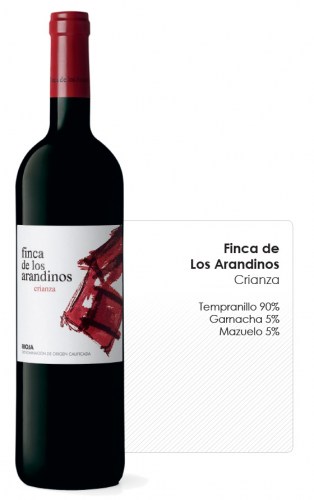
FINCA ARANDINOS crianza_300x500

 Many readers will know that a Crianza Rioja wine must have had a minimum of 12 months in oak (that’s twice the legal minimum for Spain) though many bodegas, in the past, at least, have considerably exceeded this minimum. Indeed, this wine has had more than the minimum time in oak, but only an extra month! So, another indication that this bodega, whilst following tradition, is intent on making sure that it’s the grapes’ juice, its fruit content that is to the fore.

Again the lion’s share is Tempranillo, but there is also 5% each of Mazuelo and Garnacha. Grapes are carefully selected in the vineyard and a blend is made from different plots. Once fermented ageing is 80% in French oak with 20% in American oak. The resultant wine is fruit first with extra depth of flavour and complexity added by the judicial use of oak. If you like a good Rioja Crianza, this is most definitely for you. (8€)

The final red wine, so far – there may be plans in the future to add to the portfolio – is called El Conjuro. It’s a limited production wine that has been given some red carpet treatment. The 2010 is made with Tempranillo again but this time Garnacha has a more prominent 15% of the blend. Fermentation takes place in French oak ‘foudres’ and it’s French oak in which malolactic fermentation takes please with a further 16 months ageing.

FINCA ARANDINOS conjuro_300x500

 But the wine is not ready for release yet. It stays in bottle in the depths of the cellar for a further year until the winemaker believes it is perfect for sale. However, that does not mean that it has be drunk immediately. El Conjuro has time on it’s – the 2010, tasted in early 2015, has a slight tannic grip still, indicating that there is still time for it do develop further.

It’s all about dark fruits, black cherries and blackberries, with earthy notes too, on the nose. In the mouth it is intense at first, opening up to be a subtle and elegant wine with a longer finish, leaving the taster more than satisfied with its lasting flavour and aroma. (14€)

I was pleased to see also, that Bodegas finca de los Arandinos makes a white wine as well. Eschewing the offer of the ‘new’ varieties now permitted in DOCa Rioja, this wine is made exclusively with old vineyard Viura, which has had the benefit of some time in oak. Indeed foudres are employed for its fermentation, after which is was put in French oak barrels for a further ten months, with regular ‘battonage’, stirring, with its lees.

FINCA ARANDINOS BLANCO

 The result is a dry white wine with some floral notes on the nose, a touch of citrus and an endearing, if slightly understated, creaminess. (6€)

NB These wines can be bought on-line www.fincadelosarandinos.com, please note prices above.

So that’s some of the Finca de los Arandinos information – but, why take my word for it? You can join me, October, 26th – 30th, 2015, when I am taking a small group (24 max) to stay at their boutique hotel! For more details please contact me and visit my website.

Contact Colin: colin@colinharknessonwine.com and via www.colinharknessonwine.com as well as via Twitter @colinonwine. Please also note that you can view Colin’s wine videos www.youtube.com search Colin Harkness On Wine.


Top DO Valencia Bodegas

BODEGAS CELLER DEL ROURE

& BODEGAS LOS FRIALES

DO VALENCIA

 I received a call recently from a small group of six American visitors, staying in Javea – would I be able to take them on a two-bodega tour for a day? Well, it’s what I do (along with many other wine related events etc), so the answer was an immediate and unequivocal, ‘Yes, please!’.


But where? That was the next question. In fact my new friends had already visited DO Yecla the previous week under their own steam, so it couldn’t be there. It had to be somewhere not too far to drive to and both bodegas had to be fairly close to each other, hopefully with a restaurant for lunch in between.


Well, it wasn’t difficult. I contacted my friends Miguel and Pablo, respectively of Bodegas Los Frailes and Bodegas Celler del Roure, both founder members of the Grupo Terres dels Alforins – a group of a dozen outstanding bodegas within DO Valencia, dedicated to upholding the tradition of fine wine making in Valencia.


Regular readers may remember a series of articles I wrote a few years ago talking about other members of the group, and of course their wines. To remind you, and  for those readers who haven’t already heard, and put simply, you cannot fail with any of the wines produced by the individual bodegas within this group! It would be most interesting for me to re-visit and see what developments had occurred in the interim period.


Plus, I was confident that the group of Americans would love both visits, the more so when some extra fascinating facts are involved! For example, the finca which is home to Bodegas Los Frailes was bought at auction in 1771 from the King of Spain who had confiscated it from the Jesuit Monks who had built and run it, the decade before. It remains to this day in the hands of the same Velazquez family and I’ve even seen the deeds from those hundreds of years ago!


Also, at Bodega Celler del Roure, when they were renovating the run-down property they had bought less than 15 years ago, believing it to be an ideal location to make quality wine, they were delighted to discover an underground wine cellar where stood, in good working order, a whole regiment of terracotta ‘tinajas’ where wine was made centuries ago. Indeed, these ancient heirlooms have been brought back into service, making wine – which is all part of the bodegas current success!


Our first port of call on a chilly early morning was Bodegas Los Frailes, Fontanars. The Velazquez family still lives in the old finca and still uses the old cement tanks of their forefathers. However, there is also an impressive new facility replete with stainless steel fermentation tanks and all the paraphernalia required for modern-day wine making too. Plus, sitting atop this facility is the super tasting room which has an enviable and wholly beautiful view over the vineyards which provided the raw ingredients for the wines tasted!


Bodegas Los Frailes has been officially certificated as a producer of organic wines for a number of years now, Miguel having made the decision to convert the estate to organic farming with a view to handing on a sustainable business to his children. He is now taking this laudable philosophy to the next level. Bodegas Los Frailes is slowly converting to Bio-Dynamic farming!


The phases of the moon are considered, as they were in ancient times, when deciding when to prune, plant etc. A 300-strong herd of sheep, organic fertilizer providers, were  grazing on the natural vegetation allowed to grow between the rows of vines. Special, totally organic, preparations are sprayed onto the vines during the growing season to encourage healthy vines. Natural predators which attack vine pests are encouraged to inhabit the flora and fauna nearby. Etc Etc.


And the bottle result of all this? Well, Bodegas Los Frailes continues to make top quality wine, and that’s not top quality – for organic! Oh, no – look at the guides and you’ll see that their wines are consistent high pointers in amongst all Spanish wines, organic and non-organic!


Limited space doesn’t allow me to go through all the wines, but trust me and buy with confidence! My favourites, were the lovely fruit-forward Moma, a blend of the indigenous Monastrell and the less well known, Marselan – a variety made by man by crossing Cabernet Sauvignon and Garnacha. Look out for this variety, and certainly for this wine. Under 20€.


Also the subtle and elegant 1771 (in honour of the year when the Velazquez family started their wine business) which includes on the label a copy of part of the deeds of sale! This wine’s violet, earthy, plum notes make it a wine to remember. It’s new and, priced at around 18€, it’s a real winner! (Also recommended by Jancis Robinson!). Seek, find, enjoy and lay-down too!


After lunch, which in itself was another super experience, we went to Bodegas Celler del Roure. This bodega, a relative new kid on the block, as already established an excellent name for itself. The philosophy is simple – to use indigenous grape varieties (as well as some international varieties) to make the finest wines possible blending traditional methods with modern-day thinking, and all with a keen eye on sustainability and the environment!


It’s here where the visitor will be taken to the old underground cellar to see the ancient tinajas which are still doing their job today. These earthenware pots (think Dandy/Beano Ali Baba and his 40 Theives!) are used for fermenting and ageing wines.


Pablo is intent on making wines of two different styles. He has a range of wines made in this old and traditional method; as well as a range made in the more modern away with stainless steel fermentation and barrel ageing. Tasting one style against the other is fascinating.


Favourites for me are the ‘tinaja’ style red, Parotet (with the distinctive black dragonfly label) and the oak aged Maduresa red, whose label bears a series of holes in the shape of a bunch of grapes. Plus, they have a ‘tinaja’ style white wine made with grapes indigenous to the area: Verdil, Moscatel and Malvasia, which really has to be tried!


Contact Colin: colin@colinharknessonwine.com and through his his dynamic website www.colinharknessonwine.com, where you’ll be able to subscribe, gratis, to his newsletter; as well as via Twitter @colinonwine .


Please also note that Colin is now making Youtube videos all about Spanish wines, tasting tips, wine accessories and lots more. Please go to www.youtube.com and search Colin Harkness On Wine.

DO Bullas Wine Tasting

DENOMINACIÓN DE ORIGEN BULLAS

 BULLAS DO LOGO vino-do-murcia-bullas

It’s not only a great honour to be appointed to join the judges panel of the annual DO Bullas Wine Competition – it’s a great pleasure too!


The Consejo Regulador (the Regulating Council) of this medium sized are of production in South East Spain is becoming increasingly more dynamic. Their belief, I’m sure, and it concurs exactly with mine, is that it’s time to come out of the shadows!


Let’s face it, when thinking of the zones of production here in Spain, there are other DOs that come straight to mind. Of course we think of DOCa Rioja, DO Ribera del Duero, DO Penedés et al. But it’s not just these world famous DOs in whose shadow DO Bullas has shyly stood for years, it’s also those of their near neighbours: DOs Alicante, Yecla and Jumilla.


Maybe it’s this that rankles the Consejo Regulador DO Bullas, and indeed the member bodegas, the most. After all they share the principal grape variety, Monastrell as well as very similar climates and soils and yet it’s these other DOs who are stealing the limelight.


Along with fellow judges, politicians, a horde of other invitees and the local and regional media I found myself in the atmospheric catacombs underground at the Museo del Vino, Bullas, for an excellent pre-competition tasting evening. (Incidentally, I doubt that there is another Wine Museum in Spain that is as dynamic and pro-active as this one!).

I’m not sure if it’s 11 or 12 member bodegas within  the DO Bullas, but it’s a small number and they were all there showing off their wares, which equates to a lot of wine to taste! I started with the whites – easy as there were only three!


It’s true that DO Bullas is mostly about black grapes, which means lots of red wines and also a good number of rosados. However, whilst tradition (and conditions) dictate that reds are the predominate force, it doesn’t mean that whites can’t find their niche. Exhibit A – There’s a lovely and economically priced Macabeo/Chardonnay in DO Yecla Bodegas.


Chardonnay and the aromatic Sauvignon Blanc and Moscatel varieties are permitted in DO Bullas but there were none on show, even as blends. Personally I’d like to see some experimentation looking at the make up of the soil, the micro-climate etc to see where best to grow these internationally popular white wine varieties.


Of the three whites available, all made with Macabeo, I favoured the Bodegas del Rosario for its floral perfume, over the iconic (as it’s so commonly available) Cepas del Zorro, whose finish was a little sharp for my tastes. Bodegas Carreño’s white came between the two.


There wasn’t a poor rosado wine and there were a number all vying for pole position. I like the label, the bottle shape, the colour and the aroma and taste of Rosmarinus Organic Rosado which is a blend of Monastrell and Garnacha. This wine subsequently won the Gold Medal, which is no mean achievement, given the competition.


Rebeldia from Bodegas Tercia de Ulea was full-on with its 100% Monastrell rich flavours of dark cherries and a touch of stewed plum. Cepas del Zorro has 80% Monastrell and the rest Garnacha – the blend seems just right, providing a super raspberry and redcurrant nose and lots of flavour. Bodegas Carreño also provided a super rosado with loganberry on the nose and a slight bitterness on the finish making is a super food wine too!


There was one other rosado that stood out – for it’s colour! Bodegas del Rosario has followed the current world-wide fashion for rosado wine, making a ‘classic’ onion skin coloured, Provencal style rosé. Their representative, the charming Mara Martínez, explained to me that whilst the wine is becoming a hit in the wider, more global sense, it was difficult thus far to break down the local traditionalist barriers which dictate that Rosados should be pink!


At lunch, the following day, after judging, I really enjoyed this wine.


The night was getting on, I had to have a clear head for the competition the next day (I even, regretfully, turned down an invitation to dinner after the tasting, so devout and diligent am I, on your behalf!) so I was unable to taste all the reds. However I was impressed with all I tasted, and some were outstanding 90 pointers!


Bodega Balcona is often referred to as Bodega Partal, as a result of their first Partal wine which came onto the market some years ago, initiating an all too brief inspection of DO Bullas. They haven’t worried though, they continue to make super wines and have more in their portfolio.


I loved the vibrant plum fruit content of their Mabal 2013. It’s fresh, but wholly integrated acidity cuts through the mature tannin and oh so fruit laden flavour, plus there’s a faint hint of dark chocolate on the finish (a common tasting note for Monastrell) – more so on the 2014. It was difficult, but of the aged wines I preferred their flagship wine Partal d’Autor.


Of the reds I was able to taste (remember my dedication to the task in hand forcing me to retire early!) there were two bodegas whose red wines I thought outstanding – Bodegas Monastrell and Bodegas Lavia and I couldn’t really place one above the other.


I was delighted to recognise my friend Sebastien Boudon whose success at Bodegas Sicilia, DO Alicante, had caused him to be ‘head-hunted’ by Bodegas Lavia, which itself is a member of a group of three bodegas (I must investigate the other two!). Sebastien is French, in fact from the Bordeaux area where he learned his wine-making skills. Skills which he is putting to great effect in DO Bullas.


Lavia 2010 is made with 80% Monastrell and 20% Syrah, which has to be a winning combination, and is indeed a top class wine. The 2009 may just have beaten it, though it was close! Sadly, for reasons I wasn’t quite able to fathom. Lavia wines were not entered into the competition.


The wines of Bodegas Monastrell however were entered – and how! Two Golds and Two Silvers. Look out for Valché (priced at about 19€ but worth more for sure!) from this bodega, as well as Chaveo (about 10€) and Almudí (brilliant value at about 6·50€).


Contact Colin: colin@colinharknessonwine.com and through www.colinharknessonwine.com and via Twitter @colinonwine


You may also like to see Colin’s Youtube 2015 videos, giving tips about tasting technique as well as specific wines – please go to www.youtube.com and search Colin Harkness On Wine!

Taninia Bodegas y Viñedos Part 2

TANINIA BODEGAS Y VIÑEDOS

PART TWO

Taninia Bodegas Y Viñedos brings together, under the same metaphoric roof, five different wine producing areas: Navarra, Ribera del Queiles, Rueda, Toro and Ribera del Duero. Thus, they have the wines of five different bodegas, one in each area: Señorio de Sarría; Guelbenzu; Palacio de Bornos; Toresanas; and Vallebueno.

However, the wineries that come under this umbrella operation are practically autonomous. Indeed they were chosen to be part of the group because of the success of their wines long before Taninia became an entity. If it aint bust, don’t fix it!

The point is that whilst each retains it’s own identity, it’s own unique portfolio of wines, all five bodegas are nevertheless working towards a common goal. Each bodega strives for quality through innovation and a modern approach, but recognising the contribution of the past. It’s a winning philosophy.

Bodegas Señorio de Sarría’s Rosado Viñedo No. 5 is made from Garnacha vines that were planted in the year of my birth! Now that makes them old, and, as regular readers will know, this means that although such aged vines will produce fewer grapes, those that are produced will be richer, producing deeply flavoured wines.

TANINIA SARRÍA ROSADO

 The wine is crimson red, perhaps the classic Spanish rosado colour, though you might not glean this from the huge selection of shades available nowadays. And, yes, it does have that extra depth of flavour making it a food wine as well as being a super Spring and Summer aperitif wine.

There are strawberry and redcurrant notes with a slight whiff of red rose petal on the nose. On the palate the wine opens as it warms where, like me, you might detect the tantalising flavour of rhubarb, loitering with intent!

Orot Crianza 2005 is, for these days, quite elderly for a crianza wine and I have to say that I was expecting a slightly ‘dusty’ wine whose forward fruit was now on the back foot. Not a bit of it!

TANINIA OROT

 Having been sent straight from Bodegas Toresanas cellars where it has obviously been kept under perfect conditions, the wine retains a pleasing vibrancy, providing a lift to the more mature flavours of dark fruits and some earthiness, which is quite common to wines from DO Toro.

Tinta de Toro (aka Tempranillo) is the variety used here and after fermentation in stainless steel the wine is left to repose in French oak barricas for a year, before its, in this case, rather long bottle ageing. The oak’s influence in taste terms has tempered with age, the wine is now perfectly harmonious and drinking perfectly right now!

Staying with Tempranillo, though giving it one of its other aliases, Vallebueno Roble  2011 is made with 100% Tinto Fino. This wine is made in Ribera del Duero, a DO whose wines, I know, are very often the preferred drinking of many readers.

Bodegas Vallebueno was founded under 30 years ago. It makes just two wines: the Roble, meaning that it has had a, relatively, short ageing in oak (French and American) – six months, in fact; and the Vallebueno Crianza.

TANINIA VALLEBUENO

 Its dark cherry colour also has a brightness about it when poured into the glass, inviting you to come and join it! Slightly toasted aromas of vanilla and very faint coconut will waft towards you quickly followed by rich fruit, so typical of wines from this DO.

You’ll enjoy the first taste so much that you’ll probably not linger, swallowing quickly to make room for the next. But this time, hold it in your mouth and savour it a little longer. You’ll be rewarded with lovely brambly fruit and integrated oak notes.

Finally, though the wines here and those discussed in Part One are but a few of the range available from Taninia, I’ll tell you about Guelbenzu Evo 2010, the wine that perhaps just pipped the others for my favourite from this group. Firstly, though, a little about its area of production, Ribera del Queiles.

This wine hales from another of those Vino de la Tierra officially recognised wine making zones. Geographically, you’ll find it between Zaragoza and Navarra and it, like all of the VdlT areas, is well worth seeking out.

TANINIA GUELBENZU

 In truth I’m not over enamoured with the label on this lovely, deeply flavoured and attractively scented wine. As a party to an ongoing conversation recently between a prospective client bodega and a major league UK distributor, I had the importance of label design reconfirmed. The label will sell the first bottle of wine, the contents will sell subsequent bottles. Therefore those with an old fashioned label will be left on the shelf, without people having the chance to judge on the wine inside the bottle. Harsh, but true. And this wine should not be left there!

Guelbenzu Evo 2010 is made from 100% Cabernet Sauvignon, grapes that were surely harvested at their optimum ripeness. It’s dark in the glass and there are dark forest fruits on the nose and rich blackcurrant flavours on the palate. Its 12 months in French oak have added complexity and integrated depth of flavour. It’s a mouthful, and yet elegant too.

It’s drinking perfectly now and will age for perhaps five more years, if kept under the right conditions!

NB We have 10 places only left for an excellent Wine Pairing Dinner with Classical and Chill-Out Music at Moraira’s Swiss Hotel, Friday 8th May. Wines from Bodegas Castaño, presented in English by Señor Daniel Castaño; Music from Dolce Divas (www.dolcedivas.net). First come, first served – please contact me asap!

Contact Colin: colin@colinharknessonwine.com; phone 629 388 159; Twitter @colinonwine; www.colinharknessonwine.com; YouTube search: ‘Colin Harkness on Wine’.