De Muller Sparkling Wine from Taragonna

This article is an acknowledgment of the fact that here in Spain, whilst there are of course wonderful Cavas, there are also excellent sparkling wines, that for a number of reasons, are not allowed to be called Cava . . .

DE MULLER SPARKLING WINE FROM TARAGONNA

YOUR COLUMNIST GOES FIZZING CRAZY!


Yes, I agree! I am writing a lot of sparkling articles these days – thank you.


Oh, sorry, I see, it wasn’t a compliment, more of a comment about the number of Cork Talks that involve sparkling wines! Well, apologies if you are all but fizzed-out, but please indulge me this one more time (for now!).


I write this time, not about Cava, love it though I do. This article is an acknowledgment of the fact that here in Spain, whilst there are of course wonderful Cavas, there are also excellent sparkling wines, that for a number of reasons, are not allowed to be called Cava. Such wines are made in the same way, ‘Metode Tradicional’ (the Traditional Method, i.e. the same way in which Champagne is made, by a second fermentation in the bottle), and are therefore often similar in style, even IN aroma and flavour. Plus, they are usually extremely good value for money!


A recent tasting of five Sparkling Wines from DO Tarragona perfectly illustrated these points. Re-reading my notes now, I think I said it all – “Amazing prices; incredible value; super sparklers!”.


A selection from Bodegas De Muller was used, eloquently presented by their representative, whose card I’ve unfortunately lost! First up was the ‘Mas de Valls Brut Nature’ from Bodegas De Muller. It’s a blend of Macabeo, Chardonnay and Parellada, the former and the latter being traditional cava varieties, with the Chardonnay a relative new kid on the block in cava-land, but a staple in Champagne, of course. So, an encouraging start.

DE MULLER FIZZ brut_nature

It’s had 15 months en rima (remember the minimum for cava is just 9 months, and it’s this time that adds depth of flavour, complexity and mouth-feel). You’ll appreciate its golden colour and enjoy the freshness of this sparkler, the characteristic that we all love in fizz, and there’s more. On the nose there are hazelnuts and this blends on the palate with a very slight, Chardonnay-inspired buttery note. This ladies and gentlemen is their entry level fizz – and what an excellent price, retailing at under 4€!


Priced at around the 6€ mark(!!), De Muller Pinot Noir (yes, she of Champagne!) Brut Nature Reserva has a whole 36 months en rima under its belt (were it cava, this would qualify it for Gran Reserva status!), and is a superb, rich, yet fresh still, Blanc de Noir – i.e. a white sparkling wine made with black grapes. The 100% Pinot grapes are harvested at night to preserve freshness and super violet aromas in the finished product. Blackberries are faintly found on the palate, and as you would expect from such a ‘premium sparkling wine’, there’s is a long delightful finish.


In the De Muller mono-varietal range of three (named Trílogia) you’ll also find Chardonnay. Again labeled ‘Reserva’ this Brut Nature is in the same amazing price bracket as its fellow Champagne variety above, and has enjoyed a long time on its lees, en rima, where it has gathered depth of flavour, but not at the expense of freshness. A very slight buttery element loiters with intent amongst the typical sparkling wine biscuity yeasty aromas. Classy!


Their Muscat Reserva, the final wine of the trilogy, is a Gold Medal winner, and there’s an interesting story too! Muscat has been grown here for a long time, and because of careful vineyard management and vine selection, De Muller are able to make from this variety, three wholly different styles of wine.


The first harvest, early to preserve essential acidity, is destined for their Sparkling Wine, making racing base wine. The second harvest, from the same extensive vineyards, but different vines, of course, is destined for their dry, still white wines (watch this space!). And finally, many readers will know of the lovely dessert Muscat wines, and as you’ve guessed De Muller makes theirs from a third and final harvest of the remaining vines, about a month later than the first picking.


The Sparkling Wine I tasted, and enjoyed, has a little leafy floral aroma to add to the usual slightly raisony notes found with Moscatel. It’s a Reserva again, though this time a very slightly higher sugar content puts it into the Brut class, rather than the driest style of sparkling wine, Brut Nature.

DE MULLER f_reina_violant

Reina Violant, perhaps their flagship fizz, has enjoyed an impressive 5 years en rima! It’s made with Pinot Noir and Chardonnay and has the body and depth to partner light meats, fish and seafood as well as all manner of rice dishes. There is a pleasing slight cider-esque nose that blends in nicely with some understated tropical fruit and pleasing citrus acidity!


colin@colinharknessonwine.com www.colinharknessonwine.com Twitter @colinonwine Facebook Colin Harkness Youtube Colin Harkness On Wine.

BOTAS DE BARRO

Nicola’s Botas de Barro portfolio of fine wines pays homage to the generations of farmers who have worked these vineyards carefully tending to the vines with a view to producing excellent wines, whilst also being aware of the legacy that will be passed on to the next generation. And so on! Thus, Boras de Barro is history past and present, as well as history in the making!

BOTAS DE BARRO

AND HOW WE SHOULD ALL BE PUTTING THE BOOT IN!

botas de barro capsule botas

I know it must have been a terrible shock for Bodegas Fariña when, after months of deliberation and soul-searching, their Export Director tendered her resignation. Despite her youth, Nicola Thornton had been with the company for many years, and had been taken to the hearts of the Fariña family in DO Toro, almost to the point of being adopted into this proud family with such a wine-making history!


The emotional break for both parties must have been traumatic and for Bodegas Fariña this will also have been a potential business tragedy too! Since arriving at Bodegas Fariña Nicola has opened up 60 (yes, sixty!) new international markets for their wines, in both of the world’s hemispheres in countries as diverse as Brazil and Japan, to name just two!


The reason for the break – well, simply, after a job so well done, a desire to work for herself. Nicola wants to leave something for her children to carry on with after her, as yet long-off, retirement. There was of course, no falling out and I’m sure that she went with Fariña’s blessing, after they had no doubt implored her to stay, probably also offering to fill her so well travelled cases with gold, if she’d only stay!


Spanish Palate (www.spanishpalate.es) is Nicola’s new project (more on Spanish Palate in forthcoming Cork Talks!) and underneath this business umbrella is the exciting project which is the subject of this week’s Cork Talk. As the above title says, we should all be putting the eponymous ‘boot in’ – in our wine cellars and wine cabinets. A part of the Spanish Palate is the brilliantly named Botas de Barro (Muddy Boots) wine business, that is Nicola’s new baby!


I’ve had the pleasure recently of meeting Nicola and her wine making partner Alvaro Martin in Barcelona, where I was also one of the first to taste the whole range of their very impressive wine portfolio. It’s my guess that you will also be able to taste these wines soon – and I’d recommend you do!


It’s a simple concept – Spain has probably the largest number of hectares of old, low yielding vineyards in the world, resulting in an amazing array of stunning wines. Nicola asks the question – have we ever wondered how many old, muddy boots have worked these venerable vineyards over the decades and even centuries?


Nicola’s Botas de Barro portfolio of fine wines pays homage to the generations of farmers who have worked these vineyards carefully tending to the vines with a view to producing excellent wines, whilst also being aware of the legacy that will be passed on to the next generation. And so on! Thus, Boras de Barro is history past and present, as well as history in the making!


Firstly the pleasing thing about all these wines is that they are A. Fruit first wines; and B. uncomplicated, and dangerously easy to drink!


One of the favourite areas of production for white wine in Spain these days is DO Rueda, home to the indigenous Verdejo grape variety, whose tendency to oxidise too soon, spoiling the wines, has now been well and truly mastered – as regular readers know, by a combination of technology and technique – with a liberal sprinkling of investment too!


With some of the same aroma and flavour profiles of the much loved Sauvignon Blanc, Verdejo also has a few of its own! It’s firstly an aromatic variety with herby, grassy notes and that gooseberry fruit of Sauvignon, but add some vegetal green asparagus with a touch of fennel too, and you are getting close.


Botas de Barro Verdejo has all of the above! The wines come from ‘pie franco’ vines, those and their descendants that somehow managed to resist the dreaded phyloxera pest that laid waste to most of Europe’s vineyards in the late 1800s and into the 20th century. Natural yeasts are used, so you smell and taste the pure grape, rather than that which specially cultivated yeasts bring to the fore.

botas de barro verdejo con capsule

On the finish there is a pleasing, slight bitterness which makes this wine a fine choice for food – check out salads, fish, seafood, all super partners.


Botas de Barro DOCa Rioja is made with 100% Tempranillo – this is the ongoing theme of the portfolio, all are mono-varietals.  It’s 2014 and is what is these days termed a ‘roble’ wine – meaning that it has some oak ageing but isn’t a Crianza or a Reserva as the barrel ageing is less than is required for these two disciplines, because that’s the way the winemaker wants it.

botas de barro rioja con capsule botas

The 8 months that the wine has enjoyed (and I use the word deliberately!) in American 225 litre barricas has added a little structure, some extra depth of flavour and a touch of complexity, without taking anything fro the up front red fruit delivery, with a little, faint, blueberry back-up!


I’ve tasted some excellent Jumilla wines recently. Monastrell is king here and the old, bush vines that have provided the fruit for Botas de Barro really have done an excellent job! Older vines equals fewer bunches, as Cork Talk regulars know, but the grapes that are formed are particularly rich.


This comes out in actually quite an opulent form in this ripe, darkly coloured juicy red. Once again the full fruit is backed up by some oak ageing adding depth and mouth-feel. There’s a long finish that ends with a slight reference to dark chocolate liqueurs, without the sweetness! Super!


Though not quite unique, Garnacha Tintorera is nevertheless one of the very few of the world’s grapes whose flesh is coloured (cut a black grape and a green grape in half and you’ll see that the contents are the same colour!). The Botas de Barro DO Almansa wine made with this variety is, as you would imagine, a lovely dark, almost opaque colour.


On the nose there is a touch of minerality with perhaps a faint whiff of herbs too, though it’s the fruit that you’ll notice when it hits your palate. The vines that produced this fruit are about 30 years of age, so moving into the old vine category again. It’s rich and fruity with a refreshing acidic lift on the finish, which h keeps it fresh as you reach for the glass, again!


Finally I tasted the DO Ribera del Duero entry into the Botas de Barro range. This wine comes from one of the oldest co-operatives in this, now famed, region and proves yet again that there is no problem buying wine made by co-operatives. The vines here range from 40 – 80 years old, some of which are also ‘pie franco’. It has the Botas fruit driven profile, of course, and this is aided and abetted by a certain structure, depth and complexity provided by the venerable old vines.


Now – I know you are probably wondering about the price. Well the price of the whole range is an excellent value for money 6·99€, and you’ll be delighted with your purchases! So – put the boot in!


Contact Colin: colin@colinharknessonwine.com www.colinharknessonwine.com (also see here the new sponsors!) Twitter @colinonwine Facebook Colin Harkness


NB The next www.totalfm.es Total FM 91·8 Fine Wine & Gourmet Dine Programme, sponsored by DO Yecla, is on Sunday 29th May, 18:30 – 20:00 hrs (an extra 30 minutes due to popularity!).

Cava de Paraje Calificada!

CAVA DE PARAJE CALIFICADA – POR FIN!

AT LAST – THE NEW PRESTIGE CAVA DESIGNATION!

DSC05997

In the stunning setting of the Gaudi designed Palau de la Música Catalana, it wasn’t just the exquisitely played Bach that was music to my ears! The Cuarteto de cuerda de la Orquestra de Cambra del Penedés (the Cambra del Penedés Orchestra’s String Quartet) played Bach and Eduard Toldrá at the conclusion of the official inauguration of the new Prestige Single Estate Cava designation. It’s the official approval of this exciting innovation, that also brought music to my ears!

DSC05992

It’s been a long time coming!


Two years ago I was invited to the DO Cava HQ, where I met and interviewed the President of the Consejo Regulador DO Cava, Señor Per Bonet. Some readers may remember my subsequent article – if not you may like to find it here www.colinharknessonwine.com click Articles and scroll downwards, as it will give a little more background to today’s Cork Talk.

DO CAVA SEPT 2014 067

With Señor Bonet (again, it’s in the archives as above), I toured Bodegas Segura Viudas – a most fascinating and illuminating visit; enjoyed a sumptuous lunch paired with magnificent, perfectly chosen Cavas, of different styles; and of course had the opportunity to learn from the President, exactly where Cava was going, under his direction. As I left, the charming Sílvia Grimaldo Martinez, styled, Cava Manager, assured me that I would be kept informed re developments. As anticipated, Sílvia was as good as her word, and the moment the news broke about the planned change having finally been Governement approved, as discussed with Señor Bonet, she sent me an invitation to the rather grand (formal dress – in June, me!!) launch.


The Denomionación de Origen concept in Spain is designed to protect special food/drink producing areas, where tradition and excellence have been the hallmarks for many years. There are DOs for Cheese, Meats, Olive Oils and other foodstuffs, and of course there are DOs for wine. Establishing a DO is a lengthy operation, with many hours of research, reams of official reports, much canvassing, many meetings, a considerable financial input, and so on. Eventually, the application is made to the Spanish Ministry of Agriculture and, as is the way of Government, there is of course a time consuming process through which the application must travel.


You can therefore imagine that when the President opened the inauguration, it was with a real sense of relief that he said, in Spanish, something to the effect of, “Welcome, at last, to the launch of this new designation . . .”.

DSC05994

The logo, which you will soon start seeing on certain, special bottles of Cava, is cleverly designed – it says it all. As you can see from the photo, it’s a lower case ‘p’, where the rounded part is a ‘c’, back to front (standing for cava), leaning on the straight part, which in fact is the number 1. Essentially, the design is telling us that this is Cava at it’s absolute best, the top of the quality pyramid, the number one style of Cava.


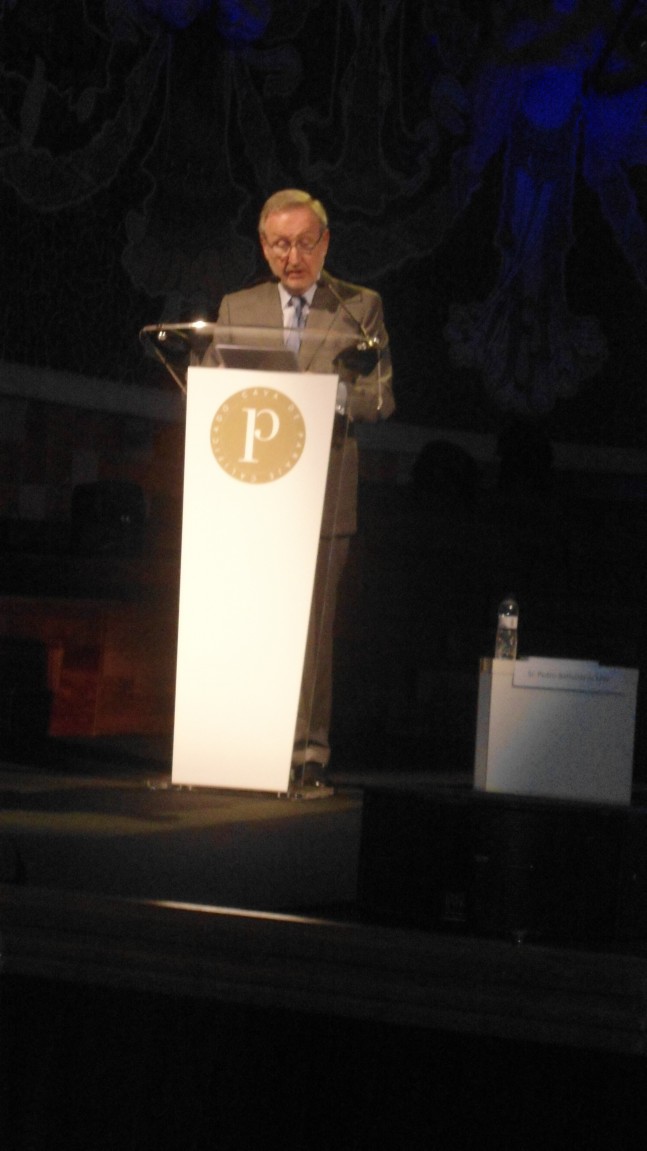
So what does it all mean? Well, there weren’t just officials of the National Government present, nor just those of the Catalan Government, nor, indeed members of the Consejo Regulador, to explain the significance. There were two Masters of Wine (one, Spain’s only MW, Señor Pedro Ballesteros MW, via a phone link, from, I think London) and the also charming, Lenka Sedlackova MW, from the Czech Republic, who has only recently been elevated to this top echelon of wine experts, making her one of the newest MWs, and probably the youngest too!

DSC05995

Plus, Guillermo Cruz, Mejor Sumiller de España 2014, which is just one of his several awards, whom I also heard presenting a tasting at Alimentaria this year. And, making up the quorum on stage, Yvonne Heistermann, Champagne Ambassador of Germany, which again, is only one of her impressive titles!


All were in favour, with perhaps Guillermo being the most gung-ho, and Lenka, taking a more pragmatic standpoint, also adding some words of caution. The general consensus, amongst the panel members, the Government Officials, and indeed the whole assembly, was that this was a move in exactly the right direction. And, as you’ve probably gathered, I’m also very positive about it.


The idea came about as a response to some sustained criticism of a few years ago where producers within the DO, and commentators outside, expressed concerns about consumer perceptions of Cava. It’s been a long, and at times painful, story, which has been told before. However, DO Cava has responded to the complaints with an on-going and successful campaign to raise the international status of Cava.


A major ‘offensive’ where DO Cava is at pains to promote the concept of Premium Cava, which essentially means Reserva and Gran Reserva styles of Cava, and indeed how such sparkling wines can be paired perfectly well with the varied dishes served throughout a dinner, continues. Readers will remember the Cava Dinners that I presented, with this promotion in mind.


Now there is another strand – the concept of the Single Estate Cava, Cava de Paraje Calificada, which, as discussed, will be considered the very top level of Cava. Certain stringent rules will have to be satisfied before producers will be allowed to use the coveted title for some of their Cavas.


Firstly, of course, all the grapes will have to have come from a single vineyard, or indeed a single plot within a vineyard. The idea of this is that such plots will clearly have but a single soil type and micro-climate, therefore the resulting Cava will be representative of that terroir. This answers very nicely a criticism that has always been leveled at Cava, from those who are lovers of just Champagne. Now there will be a definite sense of place.


Also, the vines have to be a minimum of 10 years old, though most will be many years older. The older the vine, the fewer the bunches, but the better quality and richer the grapes. Yields will be strictly controlled. Also these superior grapes must all have been picked by hand and must undergo strict analysis in the bodega, with only the  very best being selected to make the base wine, that eventually becomes sparkling Cava, after its second fermentation, provoked, of course in bottle.


As part of the quality control there will be a panel tasting of both the base wine and, following the second fermentation, a tasting of the Cava straight after disgorgement, with only those which tick both boxes being passed! Disgorgement, by the way, will only be allowed after a minimum of 36 months, that’s three years, ‘en rima’ – which will of course ensure depth and complexity in the finished article.


To conclude, I’ll leave it to the very grounded, ‘tell it like it is’, Lenka Sedlackova MW, who said that there is still a way to go in educating the buyers and through them the public about this niche market, but who also concurred that this impressively tightly defined new concept, Cava de Paraje Calificada, will elevate Cava to the same level as Prestige Champagne!

Well, after all that we needed some Cava, claro, and excellent tapas too!
Well, after all that, we needed some Cava, claro, and excellent tapas too!

The first bottles should be on the market by Christmas 2016 – I’ll let you know!


Colin’s next Fine Wine & Gourmet Dine Programme on Total FM 91·8 and www.totalfm.es will be on Sunday 26th June from 18:30 – 20:00 hrs. Sponsored by DO Yecla and the Swiss Hotel Moraira.

NB Then, rather than the two week wait for the next programme, I’ll be on again on Sunday 3rd July, same time!

CAVAS VIA DE LA PLATA

The secret of the success of the Via de la Plata Cavas is in the vineyard and then the resulting base wines . . .

CAVAS VIA DE LA PLATA

DO CAVA, FROM EXTREMADURA!

BOTTLES PLUS 001

Although the Via de la Plata (the Silver Route), which runs through Extremadura, taking pilgrims to Santiago de la Compostela, does eventually lead to the ancient metal mines in Northern Spain, the name does not in fact refer to Silver. Historians are undecided – the Roman school of thought suggests that the name is derived from either ‘platea’, meaning ‘wide road’; or ‘Lapidata’, meaning ‘stone road’.


The Arabic school believes the name came from the Arabic word ‘Balatta’, meaning, rather prosaically ‘road’. (Stick with me, you get history here too!).


However, for me ‘silver’ is closer, or rather ‘gold’ – liquid gold!  I’m talking Cava here!


Perhaps readers remember a ‘Cork Talk’ of a couple of years ago, when I explained, to those who weren’t aware, that Cava is one of the few Denominaciónes de Origen that is not restricted to one geographical area? There are others, but none more famous than that of the prestigious sparkling wine of Spain, known as Cava!


One such area is about as far away from Cataluña, considered by many to be cava’s natural home, as can be – in Extremadura, the Comunidad adjacent to Portugal, whose capital is Badajoz, and where the fine wines of DO Ribera del Guadiana are also made. The cava making industry (though I don’t like this word, crafting cava is not industrial, it’s more of a labour of love!) is centred around Almendralejo.


The first bottle of Almendralejo Sparkling Wine was produced in 1983. Application to be approved as an official cava making area was accepted in 1985. They’ve never looked back since, though they’ve been perhaps a little shy about promoting these wines from DO Cava’s western outpost. Shy that is until Bodegas Via de la Plata decided to up the ante!


I was delighted to receive a selection of cavas from this bodega (whose sister bodega, Vino Vallarcal, also makes a range of still white wines – also received, and awaiting tasting for another Cork Talk soon!). It is clear to me that Cava is alive and kicking way out west and if you can find any (this has to be the next promotional step) – buy with confidence!


The secret of the success of the Via de la Plata Cavas is in the vineyard and then the resulting base wines. When considering cava we often overlook the efforts of the growers who spend so much of their time tending the plants that produce the grapes, year in and year out. We often tend to forget the importance of the base wines too.

Readers will know, of course, that most sparkling wine, certainly cava, is made by provoking a ‘second fermentation’ within the bottle. This, of course, presupposes that there has been a ‘first fermentation’. It is this initial fermentation, performed in the usual way, with grape juice, yeast and warmth, that produces what is known as ‘the base wine’ which is bottled and to which is added the second dose of yeast (and sugar)* to kick-start the process over again.


Thus, base wine can clearly be seen as a very important part of the process, just as with the work that goes on in the vineyard. You can’t make good wine without good grapes, and you can’t make good cava without good base wine. Simple!


Cava Via de la Plata harvests its grapes, then selects the best bunches with which to make their base wine. It is only the first 50%  of the juice of the gentle pressing which is used for the base wines. This ‘free run juice’, as it’s known, is the best that the grapes can provide! So, following good work in the vineyards, the pursuit of excellence continues in the bodega.


The Liqueur d’Expedition* is then added and the magic bubbles start to appear!


So, that’s the background – now the results:


Let’s start with those tropical fruit notes – Via de La Plata Chardonnay Brut Nature is very dry with faint notes of slightly underripe pineapple and just a faint whiff of lychee. Along with typical bready notes (as expected from a sparkling wine) there is also an endearing nutty nose and flavour – instead of Sherry, why not try this with aperitifs of toasted almonds and walnuts? The bottles containing this wine have been left ‘en rima’ (almost vertical with the lees in the neck adding complexity and depth) for between 9 months (the minimum) and 25 months. The resulting Cava retains fresh acidity whilst being quite full too.

BOTTLES PLUS 006

Via de la Plata Brut Coupage has a little residual sugar, pushing it towards the maximum grams per litre allowed for a Brut sparkler. Those who like the Brut style but sometimes find it a little too sharp will fall for this wine. Made with 70% Macabeo (which gives the aforementioned slight cider note) and 30% Parellada (providing some delicate floral notes and elegance too) the wine is a delight to drink.

It’s the same ‘coupage’, mix, of varieties that makes up the Brut Nature version of the above. It’s dry again, and some! I loved this wine with smoked salmon and creamed cheese tostadas, where the natural, fresh acidity and refreshing faintly saline quality was able to cut through the oily fish and meld with the slightly chalky cheese! The crunchy texture of the tostada heightened the finesse that can always be found when Parellada is in the blend.

Whilst I liked the whole range of Via de la Plata Cavas, my favourite was another Chardonnay based wine – the Chardonnay Reserva. Now here is a wine that embodies all that is so great about Sparkling Wine! Chardonay, a variety that produces quite full wines anyway, id given an even greater depth by the 32 months it has spent on its lees, en rima. At nearly 4 times the minimum ageing period this wine has great presence on the palate, and yet, magically, displays all the vivacity of youth.

It’s fresh and full, punchy and elegant – all at the same time, and is one of those Cavas that will also be enjoyed with dinner. Try it with chicken dishes and turkey, as well as with meaty fish. Really lovely!

Via de la Plata also does Pink! (Please go to www.colinharknessonwine.com Biography; Media, Scroll down to Youtube)

BOTTLES PLUS 004

Finally, I have to say that the Via de la Plata Semi-Seco Cava is the best of this style that I have tasted! Yes, it’s semi-seco, but it’s quite far removed from the, for me, far too sweet cavas of this style that are all too often found – doing the semi-seco style a disservice, in my book,

Macabeo and Parellada combine again here and there’s a touch of toffee-apple sweetness to the wine. This can be paired with desserts where it would lighten the sweetness with its refreshing edge; and also with savoury South East Asian cuisine, where the flavours and aromas of the dishes would intermingle and the burning bite of any chilli would be lessened, leaving more flavour than heat.

Contact Colin: colin@colinharknessonwine.com www.colinharknessonwine.com @colinonwine Facebook Colin Harkness Youtube Colin Harkness On Wine.

Colin’s next radio programme on www.totalfm.es is on Sunday 26th June, from 18:30 hrs – 20:00 hrs Total FM 91·8. On-air fine wine and gourmet food tasting, top music plus wine and food chat and news, and competitions too!

NB then the next radio programme will be just one week after – Sunday 3rd July!