First Published in Costa News Group, March 2010

THE WHITE WINES OF RIOJA ALAVESA

THE GOSPEL ACCORDING TO SEÑOR PEÑIN

Señor Peñin with the White Wines of Rioja Alavesa

 Once again the Costa News sent me packing for my biennial trip to Barcelona for the excellent Alimentaria wine and food fair towards the end of March, proving our commitment to keeping our readers informed about the Spanish wine scene. Although smaller than previous years owing to the financial crisis and some dreadful planning on somebody’s part as there was a clash with ProWein, the major German wine fair, Alimentaria was still huge!

 For a wine anorak/investigative journalist like myself it was really fascinating – the more so when I managed to fit into my itinerary a tutored tasting led by Señor Peñin, of the internationally famous Spanish wine guide, the Peñin Guide, which is often referred to in Cork Talk.

 The title of Señor Peñin’s talk was The White Wines of Rioja Alavesa – at first the idea quite surprised me. In truth, although it’s not admitted up in the hallowed pastures of La Rioja, white wine is really an after-thought. The autonomous region of La Rioja is red wine country, some of it the finest that Spain can produce.

 White wine is mostly made for cash flow. Yes there are some whites that deserve recognition and are more enjoyable than just the ordinary, but it’s no surprise to see, in fact in the Peñin Guide, that there are only two white wines mentioned in the top 30 from the region.

 So why a tasting specifically about white wines from one of the three areas of La Rioja? Well, readers of last week’s article will know that in my opinion this was probably a deliberate attempt to fight the corner for traditional white Rioja in the face of attack by some upstarts who insist on making white wine only in the same area, and on using unapproved varieties!

 However I entered the tasting with a clear and open mind. Señor Peñin can teach me a thing or two, I know. His presentation was erudite and articulate; he was very professional, and he’d done his homework, although I’m sure many of the facts are stored in his wine brain anyway. I listened and learned, anxious to try the wines he had lined up for us.

 The first was Polus Blanco 2009, Bodegas Loli Casado. Made from 100% Viura, the favoured grape variety of the region, but not by me as in the past I’ve found is lacking in character. The vineyards are 70 years old so if they can’t make a wine with personality then I doubt Viura can. Señor Peñin found a touch of pineapple, of tropical fruit with a citrus element too. Me? Well search as I did, and open-mindedly too, I could stretch a point and say that there may just have been a touch of grapefruit. Sorry Señor, I’m not convinced.

 Next Ostatu Blanco 2009, Bodega Ostatu, 90% Viura and 10% Malvasia. This had a touch more acidity and citrus on the nose and palate and was slightly paler in colour (in other words like water!). For me the Malvasia helped the wine, giving it a little more flavour that the former, but I couldn’t find any tropical fruit again and not the ‘dry river bed minerality’ referred to by our host.

 The Erre Punto Blanco 2008, Bodegas Remirez de Ganuza, less Viura, 60% and the rest Malvasia with 6 months in oak. On first hit there was a pleasing Crême Fraîche flavour. The oak has benefited the wine but I don’t go along with the 5 years longevity Señor Peñin suggests and would ask why keep it anyway? I couldn’t find the herbs he was talking about either.

 Valserrano Blanco FB 2008, from Bodegas y Viñedoa de la Marquesa has only 5% Malvasia but was fermented in oak and left for 6 months. The more golden colour promised better things and on first taste there was a touch of honey, but this was immediately swept away by fresh slightly citrus acidity. Again it didn’t work for me.

 The final wine was one of which I expected great things – there was no Viura in it! In fact it’s an eclectic blend of actually unauthorised grape varieties – Moscatel, Garnacha Blanca, Viognier, Chardonnay, Roussane, Marsanne and Petit Courbout (about which I, and Señor Peñin, are totallyignorant).

Also this brew has had 16 months in oak, for me a little too long. There’s so much fruit and herb flavour in there it’s a shame to mask it with wood. It was the best wine of the bunch, and if it had been representative of the wines of the area, I’d be buying Rioja whites often – but it isn’t, and I don’t!
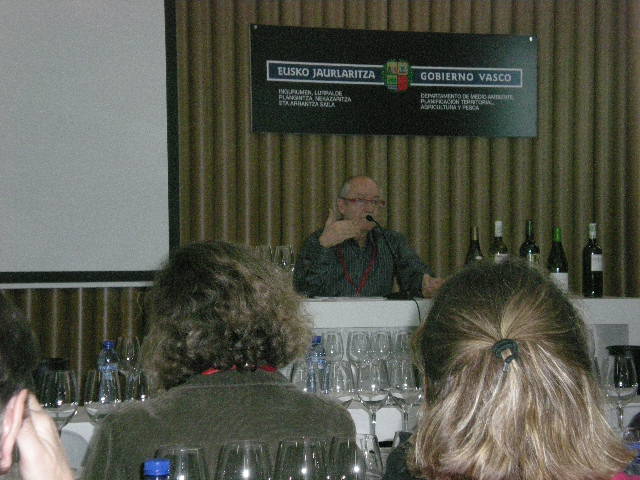
A surprisingly poorly attended Rioja White Wine tasting with Señor Peñin. At the same time the White Wine Geurrillas from the same area were being tasted with a capacity audience!

From Costa News SL (www.costa-news.com) March 2010

LA RIOJA UNDER FIRE!

REVOLUTIONARY FORCES MOUNT

SUSTAINED GUERRILLA ATTACK!

 It seems it’s ‘backs to the wall’ time in La Rioja, that bastion of

old-school, tried and tested tradition. Quoting Oscar Wilde who said,

 “Disobedience, in the eyes of anyone who

has read history, is man’s original virtue.

It is through disobedience and rebellion

that progress has been made.”

 the forces of rebellion are on the attack and apparently making ground.

 Not content with being the primary movers and shakers behind DOCa La Rioja’s, perhaps begrudging, acceptance, a couple of years ago, of three ‘foreign’ white wine grape varieties, Chardonnay, Sauvignon Blanc and Verdejo, the revolutionary guerrillas want more. And, from what I saw at Barcelona’s wonderful wine fair, Alimentaria, a couple of weeks ago, the wine consuming public are solidly behind them!

 So what’s it all about? Well a fascinating story unfolded when I sat and chatted to José Miguel Arambarri over some chilled glasses of said ‘guerrilla’ wines. There are those, and I number myself amongst them, who believe that white wine from La Rioja is the rather poorer cousin of the reds for which the area is, for the most part, rightly famous.

 I’ve said before, and even quoted Juan Muga of the world-famous Bodegas Muga who said the same thing, Viura, the principle white wine grape variety of the region ‘needs some help’. The rules adopted just over two years ago allow for the above varieties to be included in any Rioja white wine, provided that Viura has over 50% of the share. I understand their reasons for not going any further, they want to protect the integrity and identity of Rioja white. However I feel that, given the revolution, the percentage rule will change – watch this space!

 Señor Arambarri and his fellow revolutionaries have decided to create an area, within the geographical limits of the Communidad La Rioja, that is dedicated to making white wines only – it’s the only such area in Spain. It is their belief that the micro-climate, soils and altitude of certain parts of La Rioja, some of which have never before been considered as possible vineyard areas, are in fact ideal for top quality white wine production.

The Rebels ready for their assault on the old guard!

 And they’ve put their money where their mouth is! A huge investment, which is on-going, has been made in an area, Valles de Sadacia, described as a region of ‘Protected Geographical Indication’ – seemingly similar to Vinos de la Tierra (VdlT). This area makes only white wines.

 It was all started it seems by Bodegas Castillo de Maetierra who re-discovered and essentially brought back to life an ancient variety, Muscat à Petits Grains, which had died out in La Rioja 100 years ago when Philoxera hit the area (that nasty vine pest that decimated the vineyards of Europe at that time). The results of their first wines were more than encouraging and thus the Libalis range was created. The one I tasted was off-dry with a slight residual sugar content making it sweeter than dry, but not sweet – lovely.

 This success gave them the confidence to experiment, whilst their sales gave them the impetus and the wherewithal. They wanted to see which of the world-famous white wine varieties would adapt best to the Rioja conditions. So far they have settled on 8 varieties: Chardonnay (in both oaked and unoaked styles), Riesling, Viognier (which is slightly oaked), Gewurztraminer, Sauvignon Blanc, Verdejo, Albariño and Muscat à Petit Grains. I think we can expect more and it wouldn’t surprise me if we eventually see some blending too.

 So how have the establishment responded – the dyed in the wool traditionalists? Well with some, I’m told there has been hostility, some have shown indifference and a small proportion have, thus far at least, shown some measure of support. Some are, in my opinion mounting an offensive.

 Whilst at Alimentaria I attended a tasting given by Señor Peñin (more on this in a later article), the famed founder of the Peñin Guide, Spain’s best wine guide and mentioned often in this column. I was fascinated to meet him and also to learn from him. I was also interested in his subject – the white wines of Rioja Alavesa. It seems to me that the status quo in Rioja have decided that they need to bring up some big guns to defend their traditional white wines.

 This suggests to my investigative journalist’s nose that there is some concern in the corridors of Riojan power! The more so, I’m sure, when they will have witnessed that at the same time that Señor Peñin was giving his informative talk to perhaps 16 people, there was, I’m told, a huge crowd at the tasting of the Guerrilla Wines, given by the winemaker. I wouldn’t be at all surprised if the timing was a deliberate tactic!

 The label designs certainly are a deliberate tactic. The designers, the Mongarro brothers of the Brosmind Studio, had already established a name for humour and fantasy and their cartoon characters, a different one for each variety with various revolutionary style uniforms and weapons, have won several awards.

Cartoon Labels, but Grown Up wines!

 My own view, and this is really my only criticism of the whole project, is that whilst these designs may work well initially, the ideology is in fact now a little passé. For example the weird and wonderful names and labels from California and Australia, which turned people’s heads and contributed massively to sales are now perhaps a little too Nineties!

 Flippancy is fine, at first, and the labels will certainly promote sales. But I think that if the wines are to be considered serious in the future, this style will need to be changed, perhaps retaining the cartoon character, but on the back label, with a more grown-up motif on the front.

 Well it’s all very well making such a publicity splash (and of course this article is part of the fuss) but it comes to nothing if the wines aren’t up to scratch. No point in fighting for a lost cause.

 Well they needn’t worry on that score, in my view – all the Guerrilla wines I tasted were clean, fresh and characterful. Whilst there were traces of the varietal characteristics that you would expect there were also other nuances, often with herby notes. The vines are young and as the years go buy and they become more acclimatised and more mature I’m sure these wines will develop, perhaps into a new breed of acclaimed white wines from Spain!

QUESTIONNAIRE RESULTS BRING ABOUT CHANGE

Article from Costa News (www.costa-news.com) March 2010

Wine Questionnaire Results Bring About Industry Change

CHANGE AFOOT?

WINE DRINKING QUESTIONNAIRE

STIMULATES BODEGA RE-THINK

 I’m writing this on the eve of my biennial trip to Barcelona, Catalunya’s capital which also becomes the focal point for Spanish wines every other March as the itinerant Alimentaria organisation once again takes a grip on this, perhaps Spain’s most vibrant city.

 This year, no doubt mostly because of the current financial crisis that continues to darken bodegas’ doors this normally humungous fair is now only huge, taking just one of the massive pavilions rather than the two of all the previous years that I’ve been attending. However someone needs a slapped wrist, or worse, as in fact there is also another famous wine fair going on at the same time, ProWein in Düsseldorf!

 Bodegas are stretched enough financially without expecting them to have a significant presence at both events. The enormous expense of exhibiting at these fairs has to be budgeted for and when the anticipated expenditure forms land on the accountants’ desks with a resonant thud – well it can be considered as a stand too far!

 That said there will nevertheless be an enormous presence in Barcelona where all the DO’s of Spain will be represented and where there will be hundreds of bodegas showing off their wares. I love it – it’s a chance to meet up with old friends in the business to see what they are doing new, but also to see what other bodegas and areas of production are about too.

Six years ago I came back with the news that there was a major change in the Spanish wine world. Here there has never been any arrogance shown about making and marketing wine. A healthy marriage of time-served tradition and modern innovation continues to exist in Spain where fathers who learned from their fathers before them are advising their sons (and daughters) who in turn are adding their newly learned methods and technology – it’s very much a reciprocal relationship. The result is that Spain rides in the vanguard of modern European winemaking as well as in modern marketing techniques.

 Three Alimentarias ago there was a noticeable change in the labels that bodegas were using for their wines. Gone were the gothic lettering and drawings of old churches, often all covered in wire too. New eye-catching designs were all the rage then and they continue to be so – with different colours being used and all manner of ways of convincing the consumer that this wine is the one to choose before the others. Look at the wine shop and supermarket shelves. The graphic designers and artists have been given their head and wine bottles really are attractive nowadays, enticing us to buy.

 However the results of a questionnaire I recently asked people to complete suggests that wine label design needs to be revisited. I’ll be emphasising the point whilst I’m there and as with my recent revelations about how wines under five Euros can easily be found in bodegas (resulting in a concentrated advertising campaign to attract clients away from the supermarkets and back to the bodegas) I expect that changes will be afoot.

 34% of respondents said that they read both the back and front labels of wine bottles before they bought. Presumably the sometimes flamboyant and certainly almost invariably visually attractive front labels attract us in the first place but then for more information we go to the back label. However for me it is quite a shock to learn that 54% only occasionally check the back label. Clearly it is the front label that sells the wine.

 So how does this affect the marketing men and women? Well whilst it is  important to make the bottle stand out it is also clear that all other producers are doing the same. So how can we be convinced to choose one wine over another, when it is apparently only the front label that we are considering?

 It seems to me that more information has to be given on that front label, to better inform the consumer. Wine made from old vines for example is often an advantage as Cork Talk readers will know, because old vines produce fewer grapes but those that do appear are all the richer for it, creating deeply flavoured wines. Usually this information appears on the back label.

 Wine is often matured in oak casks, this can be: semi-crianza (less than 6 months in oak; crianza (at least six months in oak); reserva (at least a year in oak) and Gran Reserva (a couple of years in oak as a minimum plus further bottle-ageing). Also different oaks French, American, Hungarian etc impart different flavours and nuances. Plus there is toasting to consider, how long was the wood kept close to the fire as the cooper crafted his barrica – this too makes a difference to the wine.

 But hang on, whilst we want to advise, we don’t want to bore the client and give too much information! As you can see it’s a marketing nightmare, a dilemma that has to be addressed. Bodegas that want to sell their wines will have to have a look at their label design to see how they can continue to attract the consumer whilst also giving at least some of the information that is on the oft ignored back label!

BAY RADIO ON-AIR WINE TASTING

Bay Radio's Presenter, Noelle, enjoys a wine with her recipe of the week!

“This eclectic chicken dish has both savoury and sweet fruit elements which opens the door to both a white and a red wine. ‘Balsámico’ is a Spanish word used to describe aromas emanating from a wine that has been aged in oak in a hot area (Balsamic vinegar has of course undergone a similar ageing). However there’s nothing vinegar-like in the two wines I’ve chosen this week!
 
The red has to have a good fruit presence so I’ve gone for a very young wine from DO Toro, Primero 2009, which has been made by the Carbonic Maceration method which accentuates the youth and vitality as well as the fruit content.
 
My white wine choice is a super wine I’ve just discovered – Recato, a Sauvignon Blanc fermented in barrel with understated oak (too much oak would be a negative for this dish) and good grassy green fruit aromas.
 
Enjoy!”
 
Saludos,
 
Colin