Amber (Orange) Wines – review of definitive work by Simon J. Woolf

THE AMBER REVOLUTION!

After 21 years of writing Cork Talk (more on this soon!), I like to think, at least, that I may have made a positive contribution to the Spanish wine world. About 100,000 possible readers, at its height 150,000+, with more online, reading an average of approximately 800 words per article is, I think, not to be sneezed at!

I hope I’ve turned people on to the attractions of wines from Spain, imbuing, perhaps some, with a passion similar to mine. However, if, when I finally arrive at the great bodega in the sky, I am remembered for only two things, I hope it will be for my unerring support of Cava and, more recently, for starting the Orange Wine ball rolling, amongst expats as well as the wider community!

The reds of Spain have a history, a present and a future of great success, for sure. I’ve supported and praised them as well, of course, including highlighting lesser know areas of production. The whites have perhaps needed a little more promotion, which I’ve been happy to do, along with an increasing number of other writers, also charmed by their development. Rosado has always been popular in Spain, as well as with those from other countries now living here, or visiting often.

Amber or Orange Wine is the new kid on the block, but they’ve certainly, and easily won me over (please see www.colinharknessonwine.com click Articles and scroll down a little to my first article on Orange wines). I’m convinced that even in conservative Spain (wine world wise) we will see an extra category added to their wine lists, eventually, as Manuel would say!

However, my support of this ancient, though modern day phenomenon is but a tiny drop in an enormous qvevri of promotion and education, compared to the Amber Wine Ambassador, Simon J. Woolf, whose just published book, Amber Revolution (available here www.themorningclaret.com/shop), I’ve greatly enjoyed reading. If you are looking for a Christmas Present for your wine loving partner (or for yourself, of course) this will be an excellent fit!

Of course, it defines Amber or Orange wines (both terms can be used, though I prefer the former, so there’s no confusion, as such wines are nothing to do with oranges!), how they are made, etc, and very interesting it is too. But this work is also like the history book we would all have loved to have read when we were younger. It gives you the big picture, whilst also going into such fine detail that the reader starts to develop a relationship with the modern day protagonists of this 6,000 years old (at least) craft. It engages with the struggles of the first ever Amber Wine makers, as well as those of this century’s exponents and today’s.

And struggles there have been!

Amber wines were first made, it is believed, in Georgia. Over millennia the practise spread, though mostly in other Eastern European states. Enter two world wars and the redrawing of borders, part of the spoils enjoyed by the victors! Consider also the rise of Communism in this area, its eventual fall, and the enduring Russia. Chapter titles such as ‘Destruction and Persecution’, give the reader and insight into what’s in store! Simon J. Woolf meticulously tells the history, from the broad perspective, as well as the personal, where, for example, after a NATO led bombing of an area, one of the 20th Century’s pioneering Amber Wine makers felt unable to speak to his friend and similarly passionate equivalent in a nearby country, for years.

However, this is far from a depressing book. It’s inspiring. Think about so many obstacles being eventually overcome, and read how they were. Indeed, the book’s front cover gives an idea as to its overall positivity, where it states, ‘How the World Learned to Love Orange Wine’! And, on the same subject look at the last, what quarter, of the book where you’ll see listed so many current practitioners in so many different countries and both of the world’s hemispheres!

The photography, by Ryan Opaz, is simultaneously stunning and evocative. We can ‘feel’ the frustration of Amber Wine makers whose hands were tied, perhaps literally in some cases, during the Communist era. I also felt the loss and devastation involved when looking at a black and white photo of Oslavia, destroyed in 1916 as Austro Hungarian and Italian forces battled it out. But we can also sense the anticipation as an Amber Wine is poured by the proud maker, for Simon to taste. We can connect with the ancient world through seemingly being able to touch the iconic qvevri, the huge clay pots, buried underground, in which fermentation so often takes place. And we can ‘smell’ the old oak barrels and foudres where Amber wines are also made and/or aged.

Plus, here’s the bonus. There are seven Spanish Amber Wine producers listed, and whose wines are described, here in Spain. In fact, when Pepe Mendoza’s soon to be released wine is on the market, there will be eight, three of them in the Valencia Community!

Amber Revolution is a great read, especially with a glass of Orange wine to hand!

colin@colinharknessonwine.com Facebook Colin Harkness Twitter @colinonwine

The Irony of Wine Glasses in France!

ANOTHER FRENCH PARADOX

My lovely wife isn’t going to like this! A confirmed, committed Francophile who lived in several different parts of France, she won’t hear of any criticism of our neighbours, the French. And, following many visits with Claire-Marie guiding, I have to say that I’m also of a similar disposition.

The, perhaps incomparable, beauty of so many areas of France; the polite, courteousness of the people; the culture; the history; the architecture; the cuisine; and yes, of course, the wine – well who wouldn’t love la belle France?

And I’ve explained to her, that what’s following is for the benefit of the French – it’s criticism yes, but constructive, with a view to helping us all. But I’m walking a tightrope here – we’ll see how it turns out!

You have probably heard of the French Paradox, a phrase born of the 80s and defined thus by Wikipedia:

the apparently paradoxical epidemiological observation that French people have a relatively low incidenceof coronary heart disease (CHD), while having a diet relatively rich in saturated fats, in apparent contradiction to the widely held belief that the high consumption of such fats is a risk factor for CHD. The paradox is that if the thesis linking saturated fats to CHD is valid, the French ought to have a higher rate of CHD than comparable countries where the per capita consumption of such fats is lower.”

Well, our recent fantastic (bar one tiny, perhaps insignificant disappointment, darling, which I’m coming to here!) four week visit suggested to me, another French Paradox. For a country which purports to, and indeed certainly does, make excellent, often benchmark wines, there is a worrying scarcity in many restaurants (in fact all the ones we visited) of suitable wine glasses! There – I’ve said it! Now it’s time to hold my breath!

To me it’s fundamental – quality wine is best appreciated when it is served in suitable glasses. I was therefore surprised (and a tiny, weeny bit disappointed, honey!) when, absolutely invariably, the glass did nothing at all for the wine in the restaurants and bars we visited – and this includes Saint Emilion! Why?

Perhaps the worst example / no chance of swirling and sniffing using the glass!

Now, I know that one can go some way over the top when it comes to ‘suitable’ wine glasses. I was a touch cynical some years ago when invited to a wine tasting where, I was assured, I would be astonished at the difference Riedl glasses made to wine appreciation. Nevertheless I arrived with an open mind as well as an open notebook.

They were right – I was astonished, and indeed wrote about my conversion (to a point) in Cork Talk.

We started with a Chardonnay, Spanish I think, served in a conventional, good quality, tall, nicely shaped wine glass. Alongside it, the same wine but in a Riedl Chardonnay glass. The difference, for the better, when tasting from the Riedl glass compared to the other, was remarkable.

There were more examples to come, all ‘proving’ the same. However, the most marked difference was with the typical, and lovely Spanish ‘balloon’ brandy glass, where Riedl’s Cognac glass, which looked nothing like the balloon at all, was so much better, I wondered if some sleight of hand had been employed, a different brandy substituted! It hadn’t, and I became a believer – for sure.

There are of course problems with this, as I’m sure many of you are thinking. Surely we can’t all be expected to have a special set of glasses for Chardonnay, another for Cabernet Sauvignon, another for Albariño etc etc. And what about wines which are blends of different varieties?

However, Riedl, as well as other producers who have jumped on the glass-wagon, as you might expect, have this covered too. They all produce what can be referred to as ‘catch-all’ glasses, that is glasses in their range that will be suitable, for example, for most whites, most reds etc.

Well all this seems to have escaped the attention of many French restaurateurs – to my chagrin (see, I do try and speak French, Sugar!), and that of the chateaux whose wines are so lamentably let down!

When proper sized and shaped glasses are used, everyone’s a winner!

colin@colinharknessonwine.com Twitter @colinonwine Facebook Colin Harkness

Château Bélingard

BERGERAC

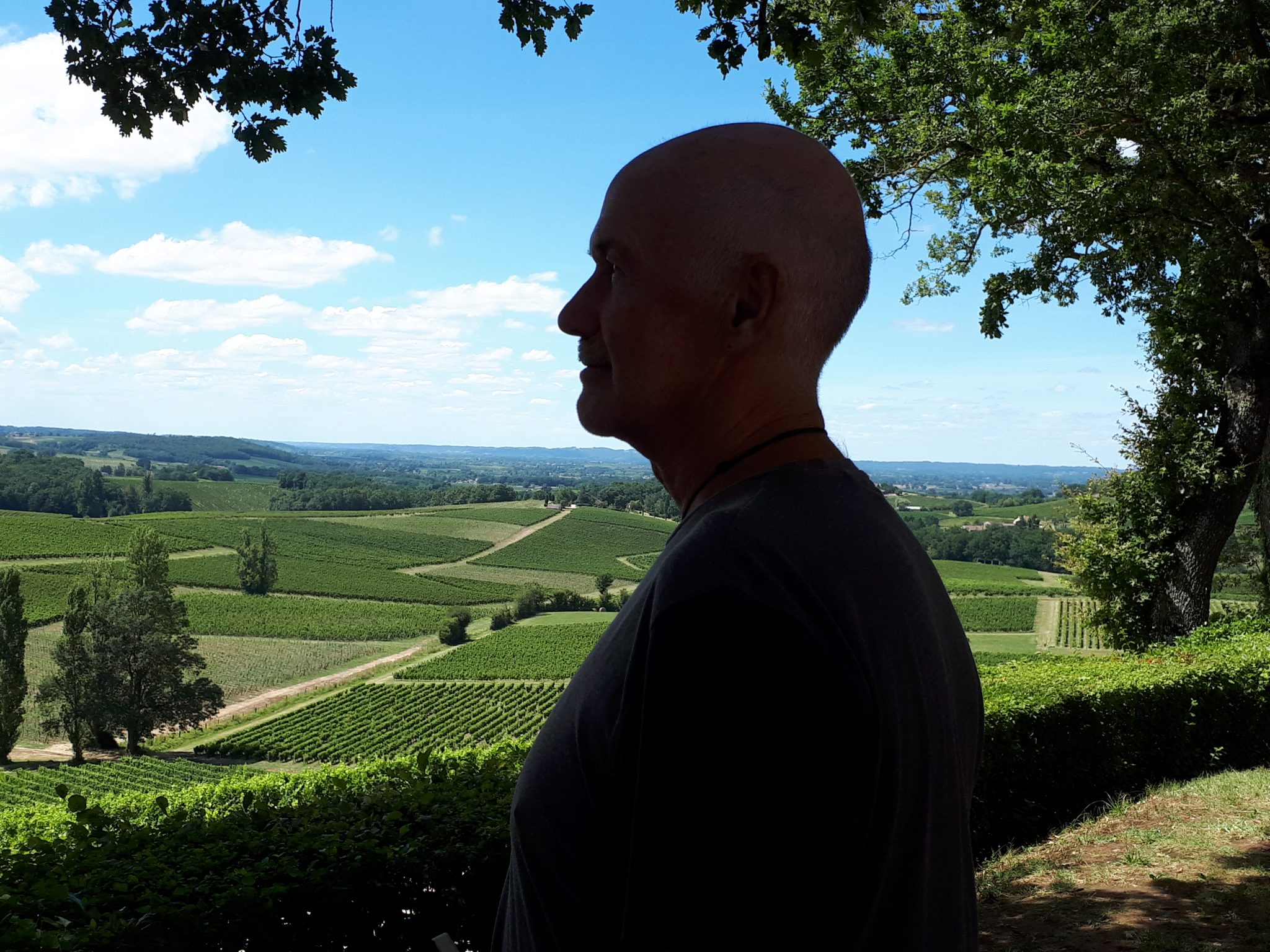
Readers who have visited Dordogne won’t need me to tell them of its beauty and charm, but those who have yet to make its acquaintance really should do something about it! We’ve just returned from four weeks in France, the first two in Charent, the last fortnight near Bergerac – and we are looking forward to our next visit!

There’s another reason too! Resting geographically in the shadow of their illustrious wine neighbours in Bordeaux the wines of Bergerac are oft overlooked. They shouldn’t be, there is real quality there, and at reasonable prices too. Plus, many of the chateaux are architecturally stunning and steeped in history.

One such winery, Château Bélingard, picked randomly out of the internet hat, from a host of other châteaux, was all of the above – and more! (www.belingard.com/en)

The antique property, whose winery has, for the last who hundred years, been owned and run by the same family, also has a rather sinister history – told to us by our charming, knowledgeable guide, Anaïs. The grandfather of the current incumbent discovered a previously obscured ancient rough-hewn stone seat, following the felling of a huge tree by a lightening strike.

Expert archaeologists were called in and determined that the small but imposing crude seat was Celtic, from the 5th Century, used by druids for human sacrifice! I won’t go into details, suffice to say that we needed a drink afterwards! And, of course we were in the right place!

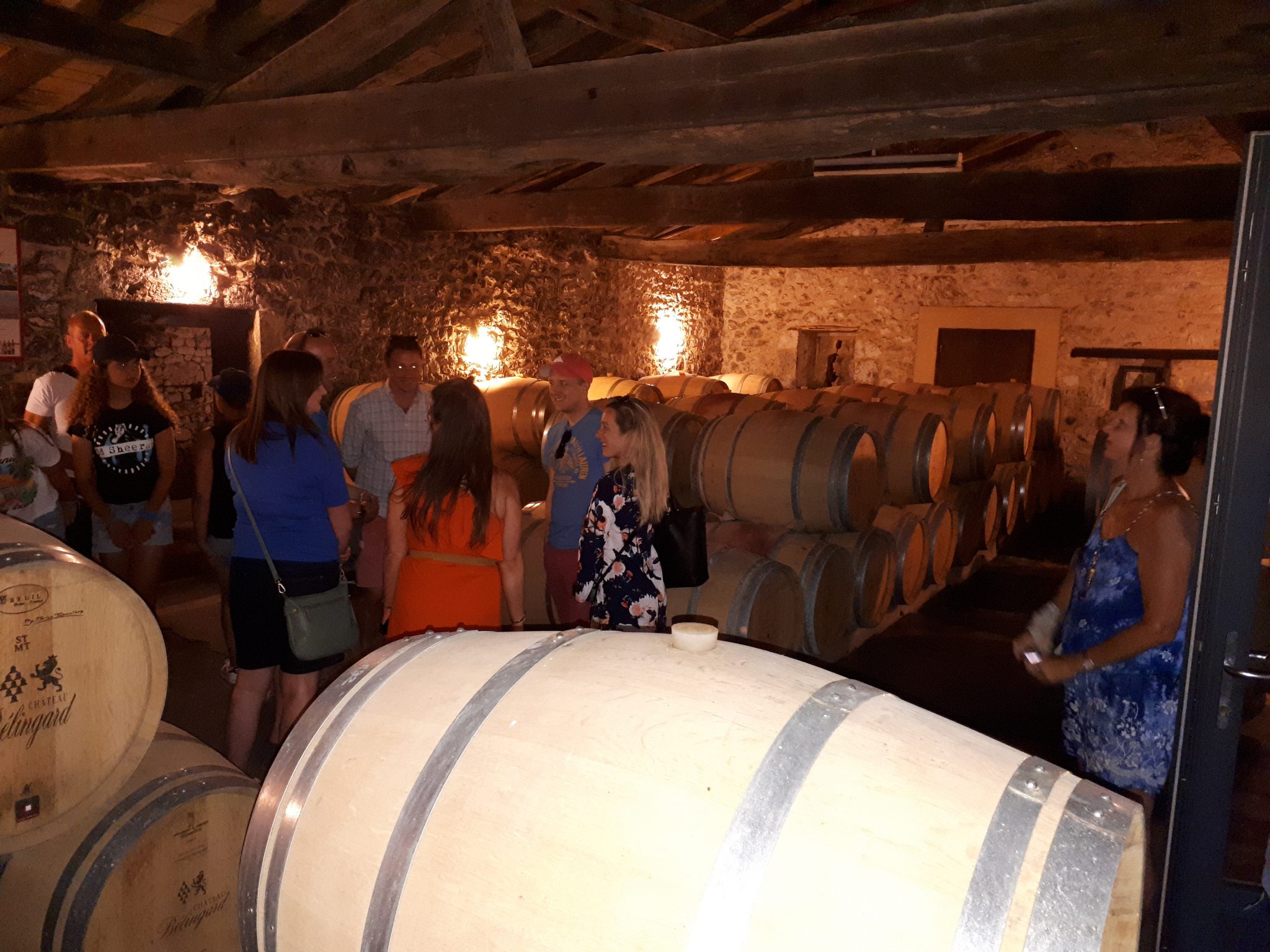
Château Bélingard (the name is derived from Celtic) is set in beautiful grounds which we briefly toured, looking also, of course, at the installations where the wine is made. 60% of the annual produce is exported, with the remainder being sold in France, mostly locally, including to a long list of restaurants and hotels. NB you can buy online!

Fermentation uses a combination of natural and cultured yeasts, taking place in stainless steel tanks, cement or oak, depending on the style of wine required, and the regulations of the AOCs with which they work. The winery sits comfortably within three different appellations: the generic AOC Bergerac, AOC Cotes de Bergerac, and AOC Monbazillac. Chateau Belingard therefore crafts, red wine, white wine and dessert white wine (this for the latter AOC, of course, whose richness comes from the botrytis fungus, or noble rot).

After the informative and entertaining tour, we were shown into the atmospheric tasting room, just outside the cellar in which all the wine-filled barrels are left in peace, to age the wine before its release. I love these cellars, wherever they may be situated – they all have that heady fragrance of maturing wine and oak!

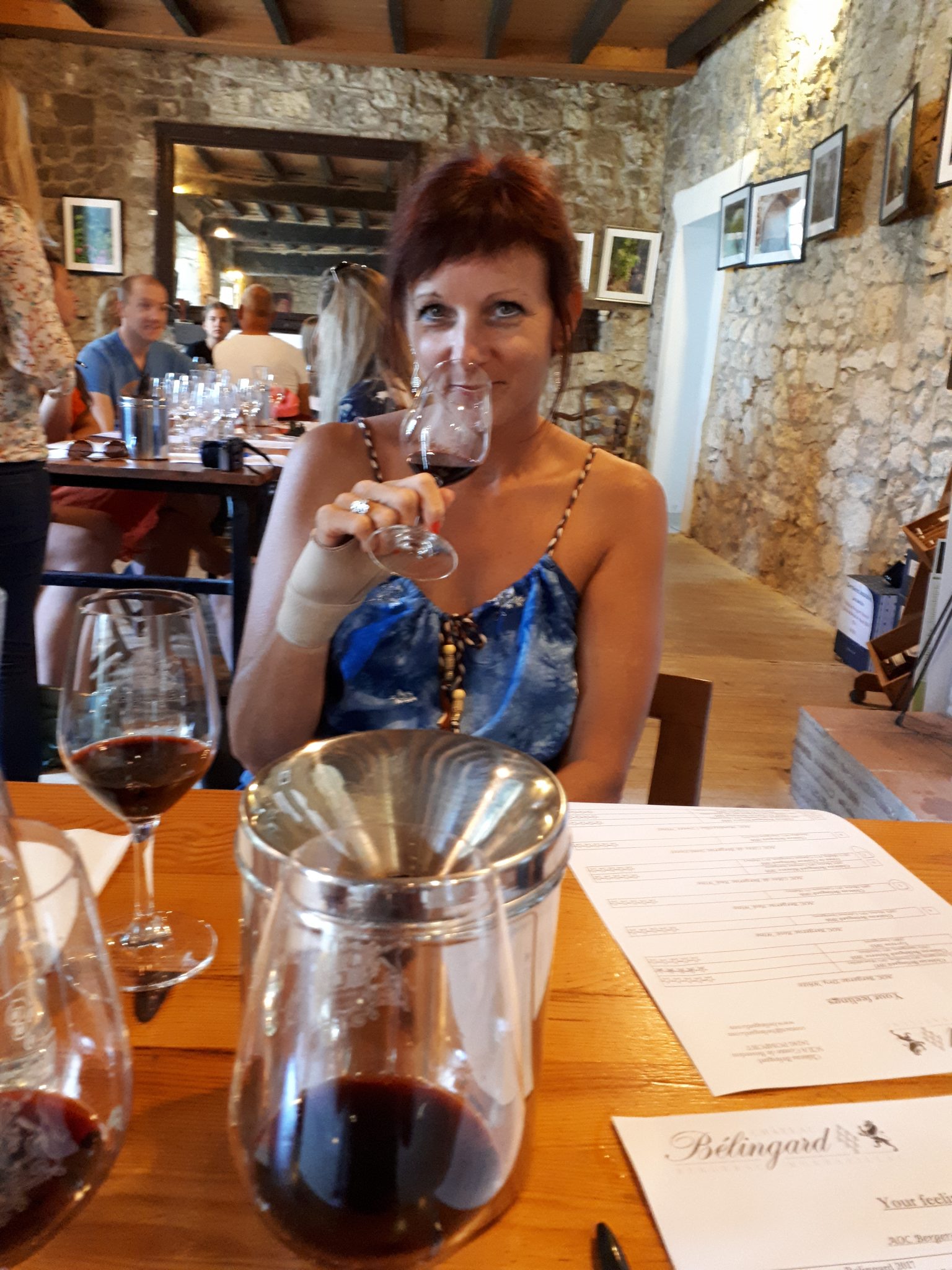
Tasting tables were set up for the small groups who had reserved independently for the tour in English. Each table was asked which four of the wines listed we would like to taste. Generous, I thought as the tour was gratis. In fact our guide acquiesced when asked by one or two of us if we could just taste one or two more! I hope the result was that sales were good – an outlay is needed for such tours, and the hope is that visitors will buy, but it’s not obligatory, of course, so there will be times when the tour becomes a loss-leader. We bought, but it wasn’t just altruism inspired, we loved the wine!

My favourite of the six we tasted was in fact the Château Bélingard Reserve 2015 white wine, made from Sauvignon Blanc and Semillon fermented and aged in oak barrels, 50% new and 50% one year old. The balance between fresh fruit and oak is perfectly judged, exemplary in fact! There’s an understated creaminess from its lees aging, with a little butter coming through the green and yellow fruit notes as well. A lovely dry white wine to grace any dinner table!

I enjoyed the reds too, though for my palate the Ortus de Château Bélingard 2015, flagship of the estate, whilst showing great potential, was still a little green, with lively tannin and needing more time to develop. That’s why we bought some, not to drink on arrival back in Spain, but to ‘cellar’ – with my writing clearly on the back labels the year when we will try them again – 2020 and and again from 2023+!

Violet flowers on the nose with dark fruits of the forest too, made with 65% Merlot, 15% Cabernet Sauvignon and 20% Malbec, three of the four permitted varieties here for red wine (Cabernet Franc being the fourth). 18 months in oak with three monthly racking.

Also from the AOC Cotes de Bergerac the Château Bélingard Reserve 2015 was ready to drink, with aging potential as well. Mature tannin on the palate with blackcurrant and damsons on the nose and in flavour, it’s made with a 50/50 blend of Cabernet Sauvignon and Merlot with 13 months in oak. Had we had more money left at this, the end of our holiday, we would have bought some too!

The Monbazillac dessert wines, were both remarkable, but in different ways. My favourite, the one we bought, was the Ortus de Château Bélingard 2015, but it was a very close-run thing, with the 2002 version (though with a very slightly different make-up). Both wines, made with Sauvignon, Semillon and Muscadelle, though different percentages, are fermented and aged in oak, the latter for 20 months!

If you need convincing about the value of ending a dinner with a dessert wine – these two will be happy to oblige! Bitter oranges, fruit cake mix, a little desiccated toasted coconut, clementine zest, candied fruit, Oloroso sherry – between these two examples you have it all! Fantastic!

colin@colinharknessonwine.com Twitter @colinonwine Facebook Colin Harkness