Our next Wine Tasting with Fine Dining and Beautiful Music will be held at Restaurante Vall de Cavall, in the beautiful countryside just outside Gata de Gorgos on Thursday 8th July, starting at 20:00 hrs.
The delicious Dolce Divas - elegance and stunningly beautiful classical and romantic chill music!
The delicious Dolce Divas, Claire Post Soprano and Flute and Kirsty Orr Piano will be charming us all evening whilst we enjoy a super 5-course dinner accompanied by the excellent wines of bodegas Luis Alegre, DOCa. La Rioja!
Please call me on 629 388 159 to reserve your place – seats are limited so please call sooner rather than later to ensure your place for another of our superb evenings where we celebrate some of the finer things in life!
There are many French wine producers who, if you catch them during a veracious moment, will tell you that it does not pay to keep your head in the sand in the competitive world of winemaking/marketing! Considerable market share was lost by chateaux that did just that as their inert, wholly inappropriate response to the influx of New World wines into Europe in the 80’s and 90’s. Some never recovered.
In Spain it was a different story. Bodegas were happy to listen to new ideas, invest in modern technology and to blend these with their own winemaking tradition. It’s proven to be a winning mix. However as many bodegas did this there was a danger that the status quo, albeit now on a higher level, would remain the same. The trick was to become pro-active rather than re-active if bodegas wanted to move ahead of their national competitors.
Nicola seals the deal with an important export client!
In my time in wine (some twenty years now) I’ve not come across a more pro-active person than Nicola, of Bodegas Fariña. Formerly of Bodegas Bajoz (where she and the similarly young team completely turned around the fortunes of this cooperative bodega until, inexplicably, the owners did an about turn), Nicola went to Bodegas Fariña where she was given her head, and where she continues to enjoy such support.
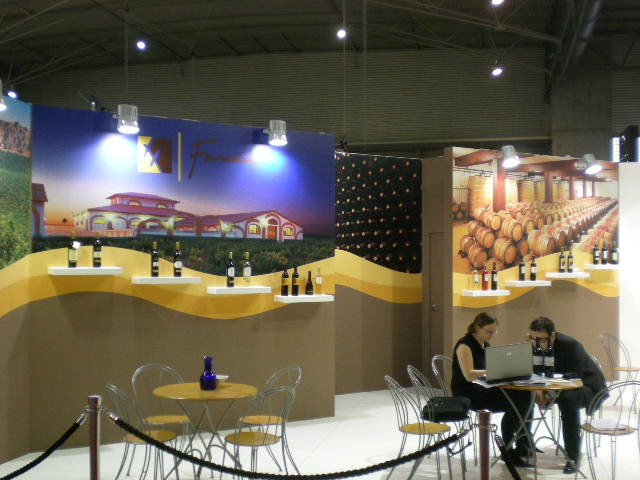
I received from Nicola several wines to taste in this new year and then was delighted to meet her again in Alimentaria, Barcelona. Over several wine tastes (incidentally, with her main distributor from India – demonstrating the strength of the export arm of Bodegas Fariña), we discussed the nature of the business, the wines we were tasting and of course the bodega’s plans for the future. She and Bodegas Fariña remain as forward thinking as ever and their increasing sales, both in the domestic market as well as in exports reveal how it is this attitude that will ensure progress during such troubled financial times.
As long as the wines are good!
Well have no fear, if you like your red wines to be darkly coloured, full of fruit character with wholly integrated oak and mineral notes too, this is where you should look.
The first wine tasted, at home in my office (equipped with various tasting glasses, decanters, vacuvins and assorted wine tasting paraphernalia) was the fresh and fruity Primero 2009, which boasts being made from grapes that were on the vines in September and in the bottle just two months later – Toro Nouveaux!
Beaujolais it’s not, however, and I mean that as a compliment. The French equivalent is made from the far lighter coloured and more delicately flavoured Gamay variety. Primero is made from Tinta de Toro (aka Tempranillo) – which, as the name implies (the blood of bulls!), is a deeper, darker and richer drop all together! And yet the carbonic maceration method by which it is made ensures that it is as fruity as you like – great start!
Next we went for the Colegiata Tinto 2009 – same year, same varieties but not Carbonic Maceration. A different style of wine, fruity for sure, with violets on the nose but a little deeper, even without wood. The Gran Colegiata Tinto Roble 2008, as its name suggests, has had some oak ageing (4 months) but that’s not all – it’s made only from the free run juice, the best juice, obtained before major pressing. Taste this and compare it with most cheap supermarket wines, whose grapes have been crushed, not pressed, mercilessly!
Gran Colegiata Crianza 2006 Roble Frances, has of course been aged in French Oak, in fact for 11 months. The trademark dark colour is enhanced by the concentrated nature of the wine. It’s spicy with elements of burnt wood on the nose and yet in the mouth it’s all fruit, dark and brambly. The Reserva 2001 also has 100% Tinta de Toro grapes but more time in wood, American, and in bottle too. It’s super winemaking as the often exuberant American oak (in-your-face, to put it in American parlance!) is tamed to be an integral, complementing element rather than ruling the roost.
The Gran Colegiata Campus is their flagship wine. There’s a nice link between the ancient Roman name for Toro, Campus, and the fact that Spain’s oldest University, now situated in Salamanca actually originated in Toro, campus and all! The grapes are hand-harvested from 50 – 140(!) year old Tinta de Toro vines and then the selection table is used to sort only the best grapes for the final choice. Taste the wine and you’ll see that all this care is well worth it! A Costa News Top Ten wine, and deserving of the plaudit!
So these are the Fariña wines tasted at home but what of those tasted in Barcelona? Well pro-active is the by-word – Spanish Sons is a brand made in co-operation with an American distributor. The play on the word ‘Sons’ is obvious in one sense, we all talk about the sunshine in Spain, but this is spelt the other way, meaning children, and the artistic label has silhouettes of the three generations that are behind the Fariña business. Made from 50% Tempranillo from the VdlT vineyards they operate and 50% Tinta de Toro from Toro.
Ricardo Sanchez is another joint venture from their VdlT vineyards, but this time with a German distributor. Vineyards of 50 – 70 years of age produce the grapes, some of which are from Pie Franco vines, descendants of the philoxera-resistant vines of another age.
If you have a look in Carrefour you’ll find Fariña wines and also in Mercadonna you’ll see the environment-friendly wines which use less glass and make less of a carbon footprint. All of the above is in the pro-active camp, as I said, but don’t expect Nicola or Bodegas Fariña to let the grass grow under feet. This bodega is at the forefront of innovation in DO Toro, all the time seeking to please the client, both with the quality of the wine and in the way they are made.
Bay Radio Presenters Noelle & Bob taste the recommended wine!
LIVER WITH ORANGE
There are a number of red wines which go rather nicely with liver. The grape variety Shiraz, now becoming increasingly prevalent in Spain, would be just right but also young Rioja or Navarra – however can they match the orange fruitiness of this particular liver dish?
Well yes, I think they can! Don’t go for oaky wines, a Semi-Crianza or Roble (fewer than six months in oak) would be the maximum if you must have your oak fix – but better to stick with a joven, fruity red of no more than two years of age.
It must have been a difficult decision but, perhaps because of three generations worth of roots, Bodegas Castaño opted to take a stand with the DO Yecla at the recent Alimentaria wine fair in Barcelona. In fact they could have done the same with DO Alicante and indeed, nowadays with DO Jumilla. Bodegas Castaño has become a triumvirate!
Bodegas Castaño (aka Bodegas Sierra Salinas and the most recent addition, Bodegas Altos del Cuadrado) is very much a rise, and rise story. During filming for Viva Vino, the Viva TV series last August, Daniel Castaño and I stood in the original Yecla vineyards (80+ years old, that’s the vineyards, not Daniel!) where his grandfather had planted the gnarled old Monastrell vines that surrounded us, which then were in the flush of youth. His faith in this indigenous variety has been born out as the wines that these vines produce is nothing short of excellent.
In DO Alicante the following September Daniel’s father and I stood, again in an old vineyard, but this time in the valley of the mountain range, Sierra Salinas, where Señor Castaño taught me some of the skills of vine pruning – again for the TV series. The Bodegas Sierra Salinas portfolio of wines is expanding, their four award winning red wines (90+ Parker and Peñin Guide points) have been joined by a rosado (lovely raspberry fruit) and a fruit driven, aromatic fresh and clean white.
I’ve yet to visit the vineyards of Altos del Cuadrado in DO Jumilla, but if the wines I have recently tasted are anything to go by, I can’t wait to meet up again with this wine-passionate family! It will be different soils, a different micro-climate, some different grape varieties (but never losing faith with the noble Monastrell) – however the one constant will be their determination to produce wines of top quality but with consumer-friendly prices.
The charming Raquel sent me two of their new wines. Jumilla also is a Monastrell area (given the Castaño’s love of, and belief in, this grape variety it would be hard to imagine them further developing their empire in an area where Monastrell was not one of the approved varieties!) so as you might imagine both wines have Monastrell in the blend.
The first has perhaps the most minimalist front label I’ve seen in Spain, simply called Monastrell 2008 it also sports the Altos del Cuadrado logo and that’s all you get! However on the back label, whilst not expansive, there is a little more information and we find that in fact there is also 10% Petit Verdot and just 5% Cabernet Sauvignon. It’s a semi-crianza wine resting in barrel (American and French) for just 4 months – sufficient time to add a touch of vanilla flavour but also some depth.
I’m interested in the blend. I love Monastrell, be it a partner in a wine or the sole variety used. I’m less partial to those wines that are made entirely of Petit Verdot. However, when judiciously used in a blend (and that for me is well less than 50% of the mix) they add a certain silkiness to the moutfeel and a richness to the flavour. Therefore as expected this one fits the bill nicely, with the addition of a tiny, but nevertheless significant, amount of Cabernet which adds colour, complexity and an almost imperceptible touch of blackcurrant.
Triple V 2006 is a step up the quality ladder. Made from Monastrell (claro!) and 15% Petit Verdot the vines that furnished the grapes for this wine are old. If you want an example of the difference between old vine wines and more youthful ones you couldn’t do much better than tasting this wine. As many readers know, older vines mean fewer grapes and therefore a more limited production – however those grapes a far richer than the young upstarts and the consequent mouthfeel and depth of flavor is easily noticeable.
It’s the case with Triple V. It’s a well rounded juicy, chewy wine whose damson and blackberry confiture flavours linger after swallowing. There’s a touch of burnt wood about it too as if the barrel toasting lasted a little longer than the usual medium time, or maybe the ancient wood of the scorched vines has some how been transmitted into the wine! But you have to look for it as it rests in your mouth vaporising and sending flavour messages to the brain via the olfactory passage. It’s a lovely wine, like its stable-mate above – and makes me ant to look out for more from this third arm of the Castaño dynasty.
Finally, I wonder if any readers remember our tasting at Bodegas Castaño
Grupo Castaño's Head Winemaker, Marciano, talks us through the new vintage wines.
last December? We tasted the 2009 vintage of their lovely Chardonnay Macabeo white wine before it went on the market in the New Year, having drunk a bottle of the 2008 at home the same week. We all felt that the oak ageing and the two different varieties were not quite in harmony at that time.
Well they certainly are now! This creamy green apple wine is a delight and I’m be looking for more!