First Published Costa News Group, October 2012

BODEGA PUERTO

JAVEA PORT’S NEW WINE MERCHANTS HOSTS WINE TASTING

 It has to be a courageous couple to open a new business on Spain’s recession-hit Costas, but Mari and Juan, of the new Javea Port wine merchants, Bodega Puerto, are exactly that!

 Juan and Mari were unperturbed by daily gloomy economic forecasts including such baffling lofty phrases as: “ Moody’s Downgrade Spanish Bonds to Junk Status”; and “Fitch Ratings for Spain free-fall to CCC Grade”, and worse (for heaven’s sake, what does it all mean?!). Plus the instantly understandable and down-to-Earth (unlike the above) sad sight of so many ghostly business premises now empty would put off most entrepreneurs. In such a climate is it wise to start a new enterprise?

 Well an early-term report suggests that Bodegas Puerto is definitely bucking the trend and I, along with a full-house of wine tasters, went along to find out about an oasis of success in what we are led to believe is a desert of recession.

 Having opened in early June, owners Juan and Mari have been pleased with the passing trade that has slowly developed over the months. Many stopped passing and became regular customers, but now the Summer tourist consumers are being replaced by Autumn tourists and this business will again change as Winter comes along.

 In anticipation of this change and natural reduction in numbers visiting the shop, Juan and Mari asked me if I’d like to present a tasting of some of their wines as a promotional exercise. Having visited the premises and having been impressed with the variety of well chosen wines, plus gastro delicatessen-like nibbles also on offer, I accepted with alacrity.

 And, when advised of the tasting, so did the maximum forty inquisitive people, within 48 hours of notification! It seems that Juan’s pre-opening research was correct in suggesting that there is a demand for a quality wine shop in Javea Port!

 We tasted five wines, with nibbles, which were served by charming family members all delighted to help and to meet potential new clients. I made no apology for starting proceedings with Bodegas Dominio de la Vega’s Cava Brut. A consistently good sparkling wine which belies its humble price bringing faint green apple flavours to the typical Cava patisserie, bready nose.

 But that’s not the only reason why I often choose Cava from this highly-rated Utiel-Requena based bodega. With Domino de la Vega Cavas you know exactly what you are getting  – just look at the back label. Here, unlike most Cavas (and Champagnes and other sparklers), you’ll see the month of disgorgement clearly printed.

 This records the month when the sediment (dead yeast cells) that caused the secondary fermentation (which is how the bubbles arrived!) is ejected from the bottle. The Cava was then immediately ready to drink and indeed will be for the next nine to twelve months. After this time (roughly, it’s not a precise science) the wine will slowly start to fade. Of course without the date on the label how do consumers know if the sparkling wine is likely to still be in good condition? Answer – we don’t!

 I applaud Bodegas Dominio de la Vega for taking this stance, their voice in the wilderness should be joined by a huge choir of all makers of sparkling wine singing the same song!

 All the next wines were made under the auspices of the famous Rioja bodega, Ramon Bilbao – which I’m sure many readers will have seen and probably tasted too. However their first wine of the evening wouldn’t perhaps have been recognised immediately as a Ramon Bilbao wine – it’s white, and it comes from DO Rueda!

 I wonder if Monte Blanco, produced by Bodegas Ramon Bilbao in DO Rueda is the result of a decision some years ago by the bodega owners to produce a white wine but out of the Rioja area and therefore not having to use the Viura grape variety? (please see Cork Talk past articles White Rioja Parts One and Two).

 No matter, the point is that this Verdejo wine has lovely, inviting bright lime green tones with hints of pure gold. The flavour is classic crisp Verdejo – asparagus, mountain herbs, long thin Italian green peppers, gooseberry and under-ripe kiwi. It’s super stuff and under 6€!

 You’d be hard-pressed to recognise also that Lucero del Alba, from Rioja’s arch enemy Ribera del Duero, is also made by Ramon Bilbao – there’s no mention of it on the label. But Bodegas Cruz De Alba is part of the group and here responsible for a Roble wine, that is a wine with some oak and bottle ageing but deliberately not enough for it to be called a Crianza.

 Juicy fruit with a noticeable acidity on first opening mellows quickly to be a fruit-led wine but with some depth provided by the American oak. After ten minutes or so just enjoy the caramel and dark fruit aromas wafting out of the glass!

 Ramon Bilbao Crianza 2009 is made from 100% Tempranillo and has had more time in oak and bottle to produce a classic Rioja style Crianza. There’s a nice balance between dark red fruit, some lighter loganberry and herby notes, particularly bay leaf, with the vanilla of the oak. Easy and delightful drinking, and with food.

 Their Reserva 2006 is a dinner table wine and if you open this wine in the UK or anywhere else in the world, you’ll instantly be transported (beam me up Scotty!) to Spain. It speaks of Spanish wine and of course specifically of La Rioja. Tempranillo is joined by the highly perfumed Graciano and the meaty, darkly coloured Mazuelo (aka Cariñena) varieties – a typical Rioja triumvirate. Bay leaves and a very distant thyme and mineral note with roasted coffee beans, coconut and dark blackberry fruit help to make this a flavoursome and deep, complex wine.

 Needless to say – they’re all available at Bodega Puerto!

 colin@colinharknessonwine.com and www.colinharknessonwine.com – are you interested in learning more about wine appreciation, individual and small group courses available!

A Life on the Ocean Wave!

I’m delighted to announce that I’ve been appointed as a Speaker as part of the Cruise Enrichment Programme for my first Cruise – with Fred. Olsen Cruise Line, in 2013.

Spain and Her Islands is the title of the Cruise on their super ship, Braemar, which leaves Dover travelling to: Lisbon, Malaga, Cartagena, Palma, Barcelona, Gibraltar, La Coruña, Dover!

I’ll be delivering five talks on the Wines and Food of Spain, with tastings of course, and as you can imagine – I can’t wait!

I’m hoping to Blog about my trip whilst actually sailing – whether that will be through these pages or another specific Blog will depend on my understanding exactly what a Blog is and how to do one!!

You’ll be able to read about it here for sure!

Great New Bodega Visit + Lots More!

November, Wednesday 21st! My advice is to put it in your diary right now, and give me a call 629 388 159 or e-mail colin@colinharknessonwine.com to reserve your seats – be quick though, we are already half full!
I have discovered a bodega near Moixent, inland from Gandia, that makes excellent quality wine, amongst the best not just in the DO Valencia but in the whole of Spain, according to Peñin Guide marks (and my own!!), nestled in fact under the mountains atop of which lie the foundations of the ancient village of La Bastida de Alcusses, an Iberian Village which was inexplicably deserted some time over 2,300 years ago!
We’ll visit this ancient settlement with a guided tour of the village and the ‘house’ adjacent which has been built in modern times but using the same methods and materials that would have been used all that time ago to give us a further insight into how the Iberian people will have lived.
Then we visit the bodega, Celler del Roure, with our guide, Pablo, the owner whose family have owned the site for many years. We’ll tour, and taste of course – including a visit to the underground cellar (easy access though) where the earthenware tinaja fermentation vessels are stored, dating back hundreds of years. Please see attached photo.

Then it’s off to lunch at the rather splendid Restaurante Mas de Monserrat, with wine – claro!
We have a maximum of 30 seats available!
All the above for just 40€! It should be a splendid, fascinating and extremely tasty day out!
Please contact me by e-mail or call 629 388 159 to reserve your seats!
These cellars date back hundreds of years!

First Published Costa News Group October 2012

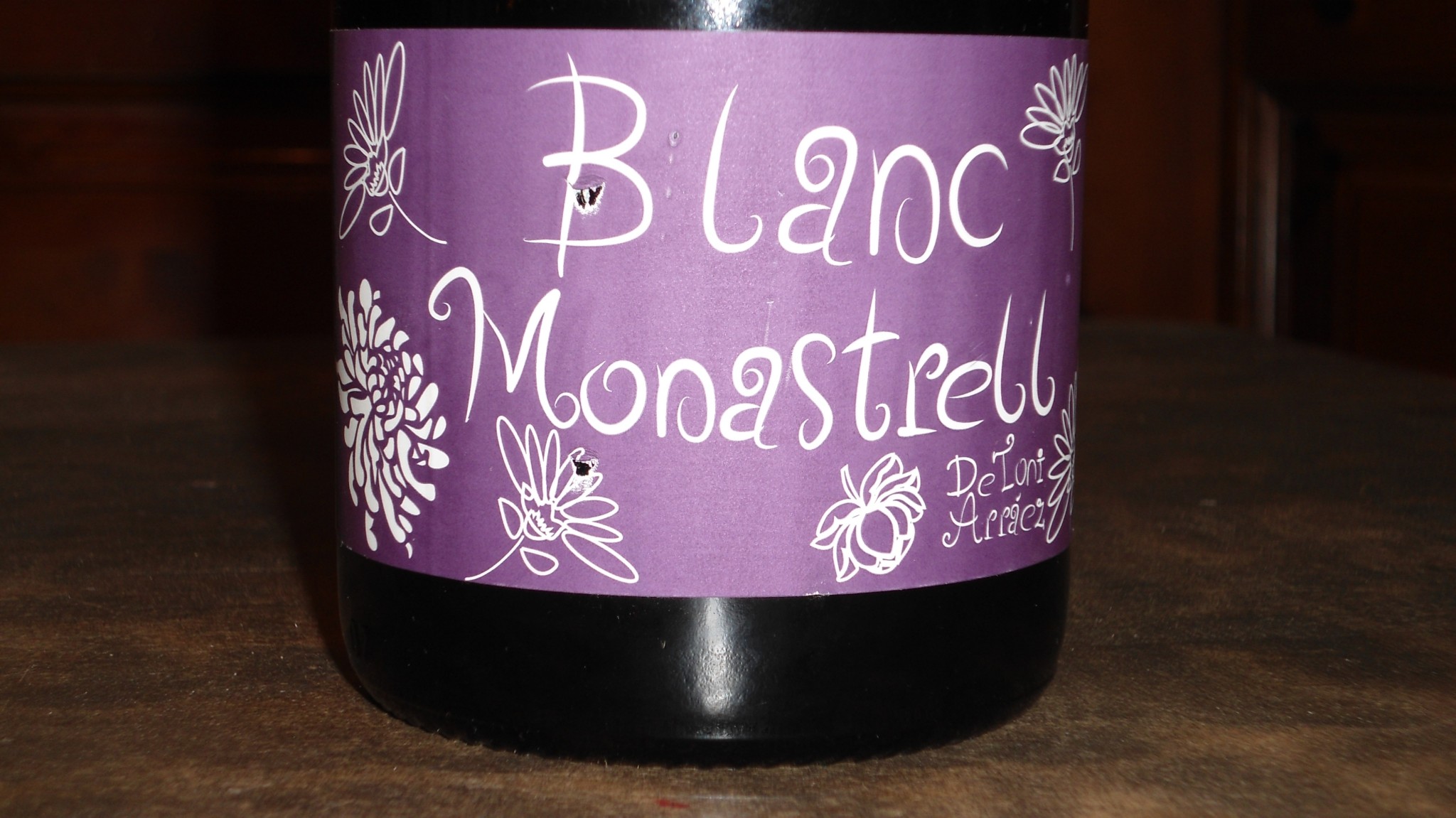
BLANC MONASTRELL

BLANC DE NOIR FROM BODEGAS ANTONIO ARRÁEZ

Monastrell Blanc from Bodegas Antonio Arráez

Perhaps you’ve heard me at one of my wine tastings explaining to those who don’t know, how rosado wine is made? It’s not, as many will know, made by mixing a bottle of red wine with a bottle of white wine. Although there are still rosados made by using black grape must (juice) mixed with white grape must, the white dumbing down, in terms of colour, the dark red, and of course adding freshness, acidity and aroma to the finished, rosé coloured brew.

However the vast majority of rosé wines are made by using black skinned grapes. Yes, the same varieties that make the full bodied, richly coloured red wines that we love: Cabernet Sauvignon, Tempranillo, Merlot et al. But how can this be?

Well, the next time you buy some grapes, black and green, just for a second take the time to cut one of each type in half and study the centre of the grape. You’ll find that the flesh of the grape at its centre and going outwards towards the skin, is in fact the same colour for black and green grapes.

The juice of both types of grape would be the same if it weren’t for the skins which are pressed in order to release the juice. The black grapes also release some of their colour and when the grape is further pressed and then the must is left in contact with the skins the colour of the juice changes to a much darker red as more colour leaks from the skins. The results is the black grape must which will next be fermented ending up with a red wine.

However if the colour leaking process is interrupted part way through – the colour of the must will be less than red, more of a pinky colour, really – rosé. Hence, while a red wine is red by virtue of the time its must spends in contact with the black skins, a rosado wine is rosé coloured because it spends less time with those skins.

Ergo it must be possible to make a white wine from black grapes by keeping the juice and the skins separate. It can’t be totally white as the pressing, albeit very gentle, is bound to release a little of the colour contained in the skin, but in order to limit this colouring as much as possible the must is whisked away from skins in double quick time!

What’s left is a juice, and ultimately a wine that has the palest of pink hues, or sometimes a little similar to onion skin colour, in fact just like the Monastrell Blanc.the wine to be described in a moment, from Bodegas Antonio Arráez.

But why do it, one may ask? We already have: white wine, rosado, red, as well as many different styles within those colours. Do we need another type of wine?

Well, for sure, such wines have a novelty value – there aren’t many produced (Blanc Monastrell is a limited production of just 2,400 bottles) and their rarity is of interest to those keen on tasting different wines. This wine will be a sell-out, if it hasn’t already. However, given the chance next year to buy the same wine – will people do so again, having tasted the first, initially just to try it, to see what it’s like?

Blanc de Noir wines (white from black) are made to satisfy a demand, albeit small at the moment (but definitely increasing) for wines that combine the freshness of a crisp white wine with the rich, depth of flavour of a red. They also satisfy a winemaker’s desire to make something different, something special.

I think it goes without saying (but that’s never stopped me before!) that such wines will always have enjoyed the winemaker’s loving attention – it’s unusual, something of a vino d’autor, and will thus be his or her ‘baby’ causing her/him to pay perhaps even more attention to it than others from the same stable.


White Wine Made From Black Grapes - Blanc de Noir!

I’m certain that those of us who have tasted Bodegas Antonio Arráez’s Monastrell Blanc 2011, will return to it next year, and so on!


The colour, pink-hued pale onion skin, is unusual but pleasant in the glass and when pouring one is treated to a burst of floral, red rose aroma with at first unidentified fruit, including citrus, lingering in the air and seemingly clinging to the sides of the glass.


Raise that glass and on the palate and the treat expands with both dark and light red fruit (blackberry, Victoria plum, loganberry) notes as well as some grapefruit abounding but with a gentle herby aroma allied to the faintest whiff of cranberry too!


It has a mid-length, dry finish which leaves the palate with a richness but freshness too. Super wine – let’s have more!

Contact Colin: colin@colinharknessonwine.com and through his unique wine services website – want to know how to obtain more from your wine, how to choose wines in a restaurant; visit a bodega; hold a wine tasting for your friends; match wines and food; etc – then visit www.colinharknessonwine.com