Thanks for the blog Colin that’s very interesting and the fact the white grapes have ripened behind the reds this year is also interesting.
Now the grapes are safe indoors and the land is enjoying some well needed rain.
Best regards
Sue & Roger
News from the vine!
Thanks for the blog Colin that’s very interesting and the fact the white grapes have ripened behind the reds this year is also interesting.
Now the grapes are safe indoors and the land is enjoying some well needed rain.
Best regards
Sue & Roger
BERGERAC
Readers who have visited Dordogne won’t need me to tell them of its beauty and charm, but those who have yet to make its acquaintance really should do something about it! We’ve just returned from four weeks in France, the first two in Charent, the last fortnight near Bergerac – and we are looking forward to our next visit!
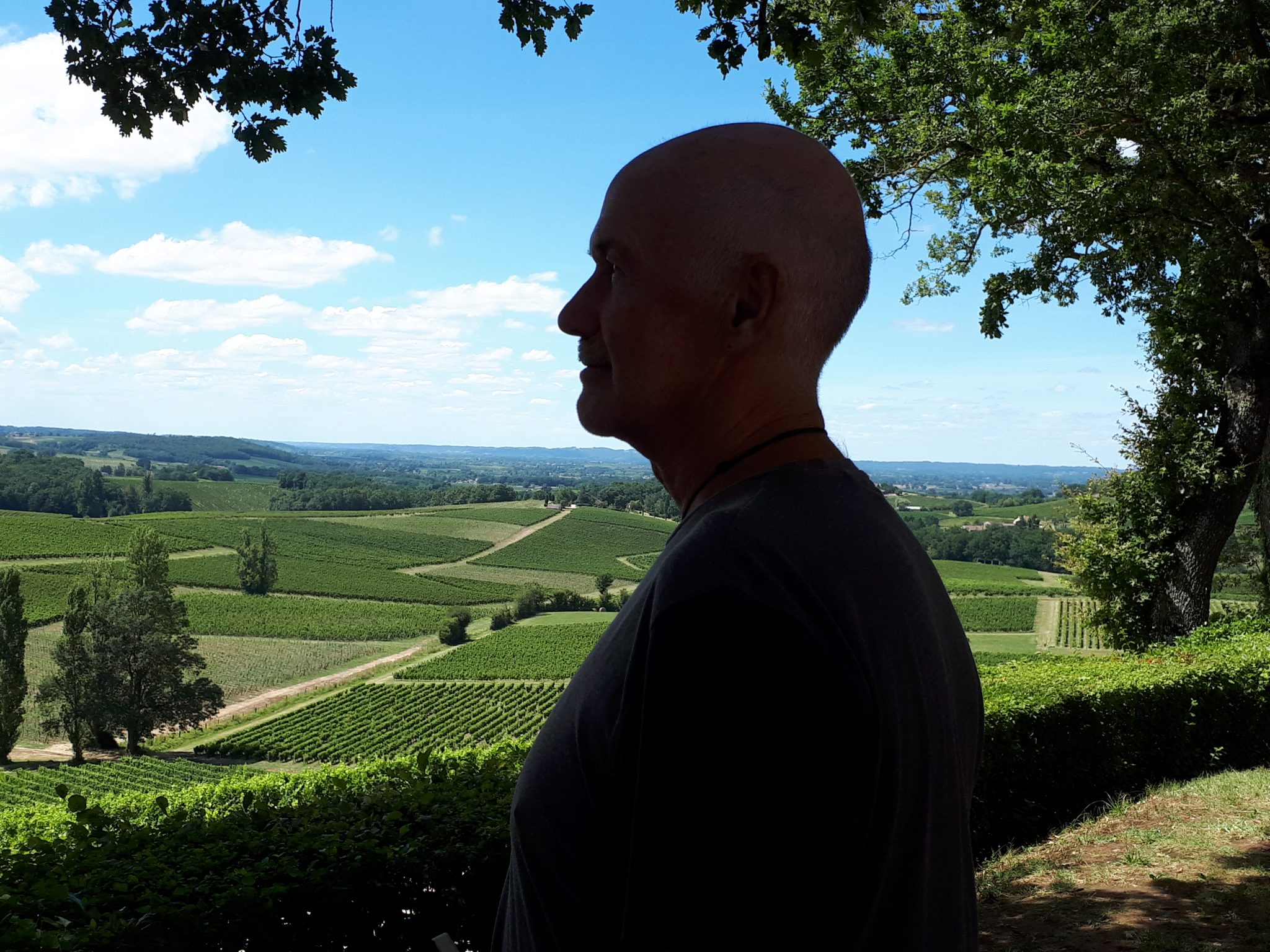
There’s another reason too! Resting geographically in the shadow of their illustrious wine neighbours in Bordeaux the wines of Bergerac are oft overlooked. They shouldn’t be, there is real quality there, and at reasonable prices too. Plus, many of the chateaux are architecturally stunning and steeped in history.
One such winery, Château Bélingard, picked randomly out of the internet hat, from a host of other châteaux, was all of the above – and more! (www.belingard.com/en)

The antique property, whose winery has, for the last who hundred years, been owned and run by the same family, also has a rather sinister history – told to us by our charming, knowledgeable guide, Anaïs. The grandfather of the current incumbent discovered a previously obscured ancient rough-hewn stone seat, following the felling of a huge tree by a lightening strike.
Expert archaeologists were called in and determined that the small but imposing crude seat was Celtic, from the 5th Century, used by druids for human sacrifice! I won’t go into details, suffice to say that we needed a drink afterwards! And, of course we were in the right place!
Château Bélingard (the name is derived from Celtic) is set in beautiful grounds which we briefly toured, looking also, of course, at the installations where the wine is made. 60% of the annual produce is exported, with the remainder being sold in France, mostly locally, including to a long list of restaurants and hotels. NB you can buy online!

Fermentation uses a combination of natural and cultured yeasts, taking place in stainless steel tanks, cement or oak, depending on the style of wine required, and the regulations of the AOCs with which they work. The winery sits comfortably within three different appellations: the generic AOC Bergerac, AOC Cotes de Bergerac, and AOC Monbazillac. Chateau Belingard therefore crafts, red wine, white wine and dessert white wine (this for the latter AOC, of course, whose richness comes from the botrytis fungus, or noble rot).
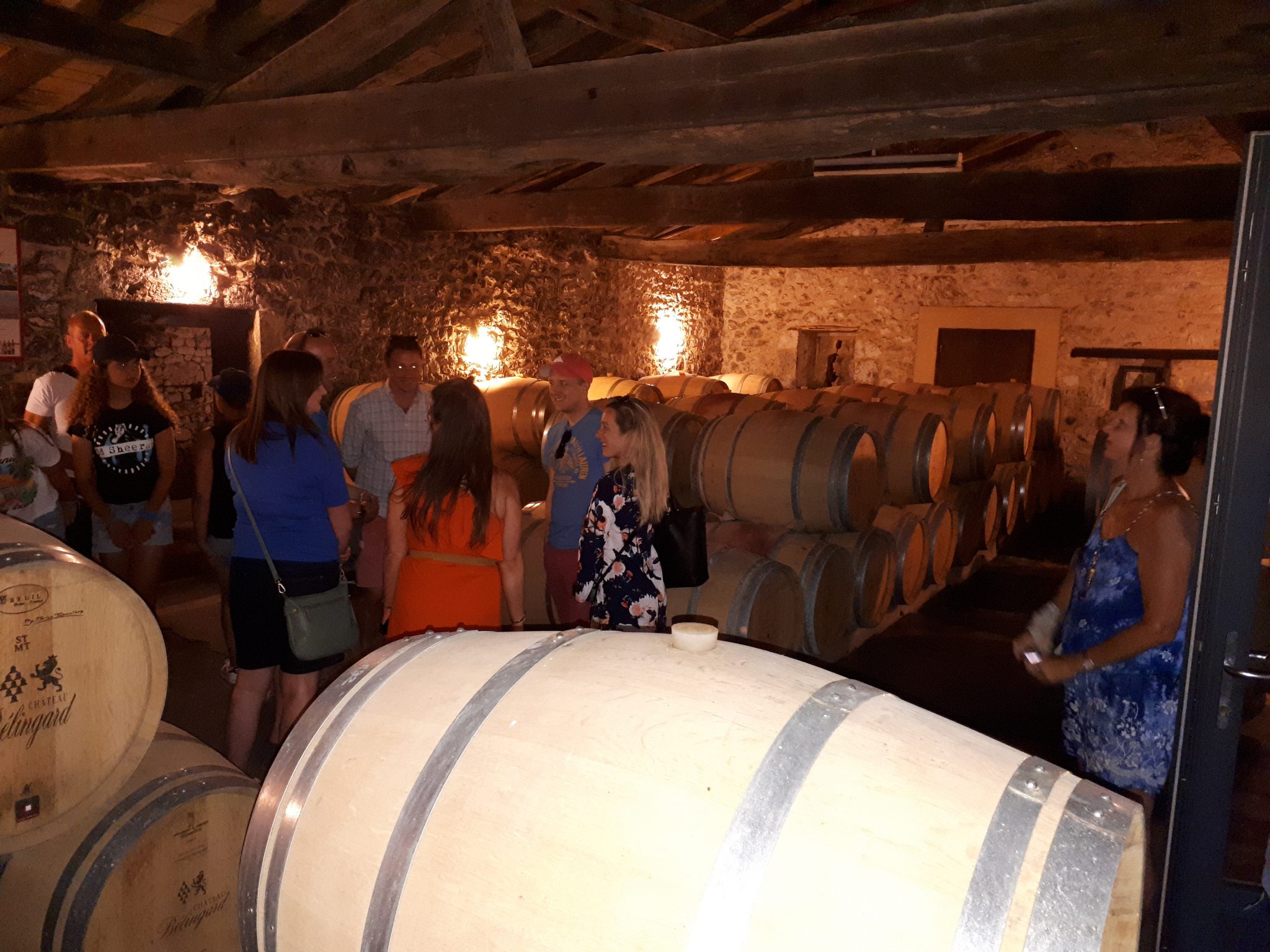
After the informative and entertaining tour, we were shown into the atmospheric tasting room, just outside the cellar in which all the wine-filled barrels are left in peace, to age the wine before its release. I love these cellars, wherever they may be situated – they all have that heady fragrance of maturing wine and oak!
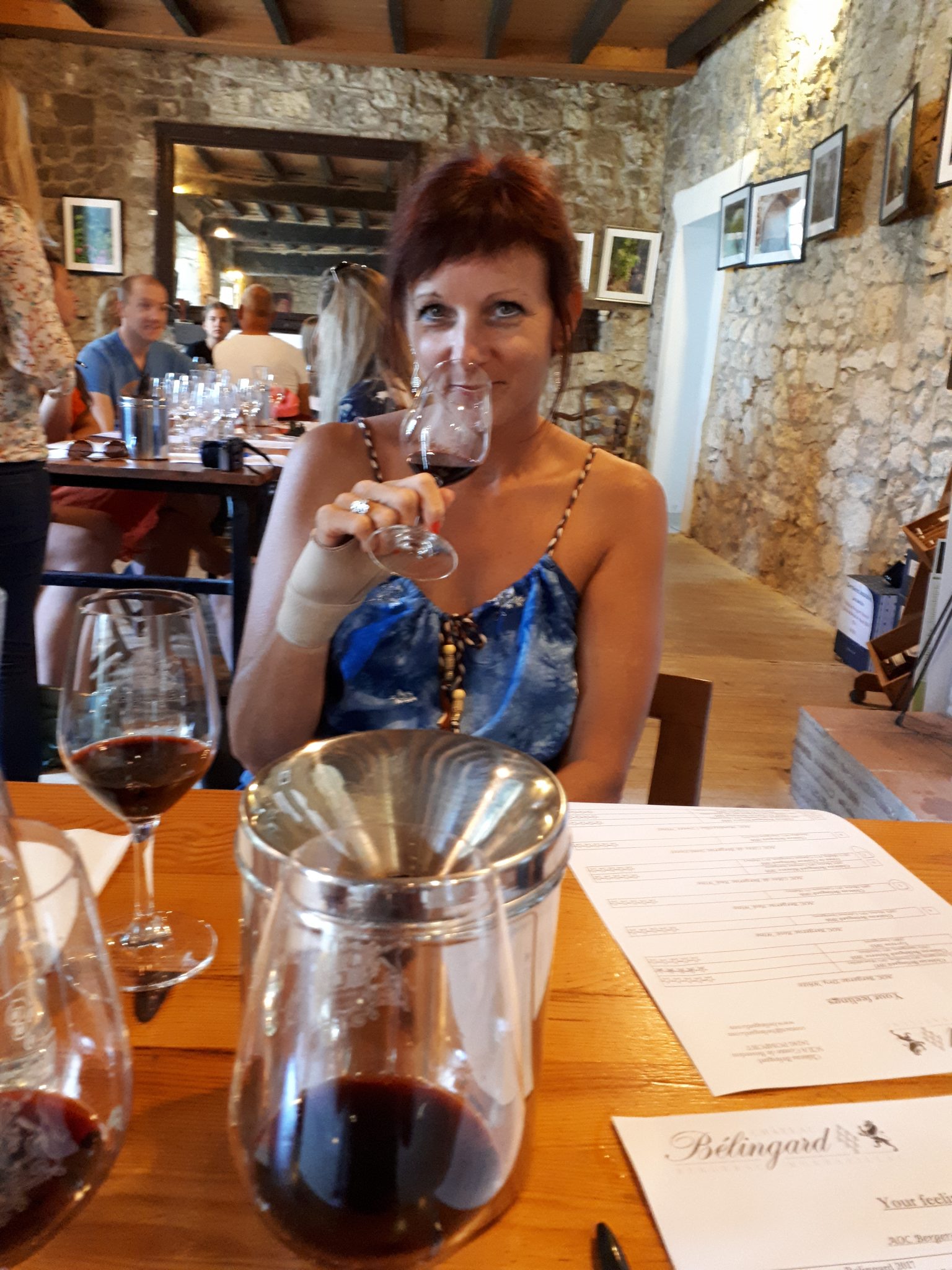
Tasting tables were set up for the small groups who had reserved independently for the tour in English. Each table was asked which four of the wines listed we would like to taste. Generous, I thought as the tour was gratis. In fact our guide acquiesced when asked by one or two of us if we could just taste one or two more! I hope the result was that sales were good – an outlay is needed for such tours, and the hope is that visitors will buy, but it’s not obligatory, of course, so there will be times when the tour becomes a loss-leader. We bought, but it wasn’t just altruism inspired, we loved the wine!

My favourite of the six we tasted was in fact the Château Bélingard Reserve 2015 white wine, made from Sauvignon Blanc and Semillon fermented and aged in oak barrels, 50% new and 50% one year old. The balance between fresh fruit and oak is perfectly judged, exemplary in fact! There’s an understated creaminess from its lees aging, with a little butter coming through the green and yellow fruit notes as well. A lovely dry white wine to grace any dinner table!
I enjoyed the reds too, though for my palate the Ortus de Château Bélingard 2015, flagship of the estate, whilst showing great potential, was still a little green, with lively tannin and needing more time to develop. That’s why we bought some, not to drink on arrival back in Spain, but to ‘cellar’ – with my writing clearly on the back labels the year when we will try them again – 2020 and and again from 2023+!
Violet flowers on the nose with dark fruits of the forest too, made with 65% Merlot, 15% Cabernet Sauvignon and 20% Malbec, three of the four permitted varieties here for red wine (Cabernet Franc being the fourth). 18 months in oak with three monthly racking.
Also from the AOC Cotes de Bergerac the Château Bélingard Reserve 2015 was ready to drink, with aging potential as well. Mature tannin on the palate with blackcurrant and damsons on the nose and in flavour, it’s made with a 50/50 blend of Cabernet Sauvignon and Merlot with 13 months in oak. Had we had more money left at this, the end of our holiday, we would have bought some too!
The Monbazillac dessert wines, were both remarkable, but in different ways. My favourite, the one we bought, was the Ortus de Château Bélingard 2015, but it was a very close-run thing, with the 2002 version (though with a very slightly different make-up). Both wines, made with Sauvignon, Semillon and Muscadelle, though different percentages, are fermented and aged in oak, the latter for 20 months!
If you need convincing about the value of ending a dinner with a dessert wine – these two will be happy to oblige! Bitter oranges, fruit cake mix, a little desiccated toasted coconut, clementine zest, candied fruit, Oloroso sherry – between these two examples you have it all! Fantastic!
colin@colinharknessonwine.com Twitter @colinonwine Facebook Colin Harkness
A BBQ’S IDEA OF A BBQ, & WINES TO MATCH!

When we received our invitation to Neil and Carol’s BBQ, to celebrate the former’s birthday, it wasn’t entirely true that all the wines we would be tasting were largely down to my having introduced them to Neil, as he actually said.
I can’t claim credit for the super Luis Roederer Brut Premier Champagne, served as a welcome drink. In fact, it could be argued that, if anything, I have been trying to turn their heads away from Champagne, incessantly recommending Cava! Also, the delightful M de Alejandria dessert wine, was a new Moscatel to me, but one to which I’m sure I’ll return.

However, I might perhaps have played a part in Neil’s choice of white wine, paired with the delicious BBQd fresh prawns; as well as the simply wonderful, exemplary DO Yecla red wine, Casa Cisca from Bodegas Castaño. After all, I did take Neil and Carol (as well as a coach load of others) to visit the bodega a couple of years ago.
It was one of those social events that one knew had to be a success! I was, obviously, very confident in the wines. Neil knows a thing or two about wine, that’s for sure, so whilst I knew very well the two I’d recommended, I was certain that the others would be of the same standard. Plus, as we’ve come to know over the years, Neil is several steps above being just an accomplished chef – his dinners, and BBQs are legendary! The food therefore was a given from the start – bound to be top class.
And of course, the company is even more important than the food and wine, albeit that this was to be a very gourmet affair. I was with the lovely Claire-Marie (www.clairemarie.es), Classical Soprano and founder member of the Claire-Marie Latin Jazz Trio, of course. And, we were delighted to find that our fellow invitees were: musicians, Pauline and Roger as well as bon viveurs, Jeanette and Dave, with whom I traded cheeky insults all afternoon and into the night, calling it an honourable draw in the end!
All was set for an excellent BBQ.
Roederer produces the hallowed Champagne Cristal Millesime Brut, retailing at well over 100€ per bottle and, as with so many wine producers, their other wines are, of course, of a similar standard, and not a lot cheaper! A high proportion of the base wine for this Champagne is barrel aged, giving the finished product greater depth and a little extra flavour too. On top of this, the Champagne stays on its lees aging in the cellars for a minimum of 48 months before it’s release! Balanced, elegant, full flavoured – a great way to start!
Regular readers may remember me singing the praises of the Albariño based wines of Bodegas Palacio de Fefiñanes, where Claire-Marie and I were once invited to attend a lunch within the castle-like, Manor House! Put simply, their whole portfolio of wines is excellent! I’d recommended them to Neil and he bought their ‘regular’ Fefiñanes Albariño as well as their rather special Fefiñanes III Año Albariño 2013, asking me to choose! Both are exemplary, but I opted for the latter, as it’s a bit different!
The Albariño grapes are hand picked, passing at least two inspections – only the best bunches are used in making this wine. It’s fermented in temperature controlled stainless steel tanks and then left on its lees, with gentle stirring for over 30 months. Albariño is a variety that revels in this treatment, giving the drinker in return a beautiful, golden hued wine which is dry and elegant redolent of peach and apricot. Excellent!
Bodegas Castaño’s Casa Cisca 2013 is probably sold out right now! It always sells out – and there’s a reason for this: it’s a wonderful wine. At 15% it looks like a big wine, and it is, yet for all its weight and body, it is fresh, plumy and elegant. If thinking yet about your Christmas Day meal – put this at the top of the list already.

When you put the glass to your lips, but smell, before tasting, the wine speaks to you, seduces you, before you’ve even tasted it. And its promise is delivered when you hold it on your palate and let your taste buds go to work, eventually swallowing. It’s a conversation stopper – and the huge rib of beef with which it was served, well, a perfect pairing if ever there was one!
Cristina Rodriguez Vicente’s childhood dream of producing a dessert wine made with her own Moscatel grapes came true in 2016, having replanted an ancient vineyard in the Teulada landscape of the Costa Blanca. The first commercial wine from this enterprise, M de Alejandria, made in the ice wine style, in fact by friend and colleague, Daniel Belda, of the eponymous bodega, is the one we enjoyed so much with a special peach dessert.

Sweet yes, as desired, but also with the crucial acidity which keeps dessert wines fresh. Honeyed ripe orange peel aromas and flavour with lovely honeysuckle and white flower fragrance!
Contact Colin: colin@colinharknessonwine.com Facebook Colin Harkness Twitter @colinonwine www.colinharknessonwine.com
MATHS – THE PART IT PLAYS IN
SPARKLING WINE APPRECIATION!

I recently spent a good half-hour, probably more, in a very well stocked, dedicated wine shop in Teulada, Alicante. My mission – to select some cava for a wine appreciating friend’s birthday. I was grateful to the maths teacher of my second year in secondary school, Southport, Lancashire – all those years ago, for helping me choose!
Why? Well, when choosing any sparkling wine it helps to have a grasp of what was called, Mental Arithmetic, in those less than halcyon days (it was a dreadful school!). However, it could all be made easier, if the sparkling wine producers played their part. Some do, but many don’t!
Sparkling wine has a shelf-life, which starts from the moment it is disgorged – that is the time when the bottle (talking Traditional Method here) is taken from the cellars where it has been resting upside-down, for at least the minimum amount of time prescribed by the authorities, and the restraining cap is removed.
The ice cube (the neck of the bottle and its contents are frozen at this point) that contains the lees (the sediment, the dead yeast), is jettisoned by the pressure inside the bottle, which is then topped up and resealed with the distinctive cork. It’s now that the clock starts ticking!
The sparkling wine is ready for consumption and will be for a length of time still – but how long? It’s here that producers can help consumers with their maths, but, for commercial reasons, many choose not to.
Clearly, we cannot even have an anything like educated guess at how long the bottle we select from the shelves will have at its optimum time for drinking, if we don’t know the date when disgorgement took place. Sparkling wine is at its peak for a certain time after disgorgement, determined by the length of time it has spent on its lees – the less time, the fewer months it will be at its best.

Unfortunately it’s not an exact science – there’s no definite equation, but there’s a general ‘rule’, providing some guidance, at least. For example a young cava which has spent the minimum 9 months ‘en rima’ (upside-down on its lees) will happily last for probably a year, perhaps a few months longer, after it has been disgorged. There are other factors involved, e.g. the age of the vines whose grapes were used to make the cava, but as a general guideline, the above is useful.
Carrying on with cava – a Reserva, which has to have had a minimum of 15 months en rima, will last longer still – certainly two years, often longer. And, a 30 month minimum, Gran Reserva – well longer still; and in all cases when the minimum time en rima is exceeded, as it often is, the cava’s longevity will increase proportionately.
But, without knowing the date of disgorgement, we are popping in the dark!

However, if other information is available, those in the know, and with a certain mathematical aptitude, can make some educated guesses. And so it was for me, when making my choice the other week.
Some of the cavas I considered did have the important date on the back label. However, I decided that I wanted a Magnum – none displayed the date of disgorgement. One, apparently, had some sort of code, which, if the consumer goes to the website, will reveal the date. But come on, who has the time to do this? How can it be done at point of sale? Who can be bothered? It’s clearly just a sop to informed consumers, a get-out clause where the producer can avoid any criticism for withholding information!

One magnum advised that the wine had enjoyed 40 months en rima, so, a Gran Reserva, with extended lees contact – but no further information. A help, when allied also to the fact that it is a magnum. Magnums hold the equivalent of two bottles worth of wine, but have the same sized neck as bottles. This means that the tiny amount of oxygen that passes through the cork, as a part of a wine’s aging process, is the same, but influences twice the amount of wine – thus allowing greater longevity. However, there is still guesswork needed here.
Another magnum of cava had its vintage date on the label and proudly stated that it was a Gran Reserva. So, I knew that I could add on at least 30 months to the date of the vintage, not far off three years, and see how close that took me to 2018, again bearing in mind the size of the bottle. But this took me only to 2014 – it would probably be good still, the more so if the minimum en rima time had been exceeded (I’ve tasted Gran Reserva cavas which have aged thus for five years and more!).
But, it’s still guess work, no matter how good is one’s maths!
My thanks for contributions from: @Wine_Cuentista, @VictordelaSerna, @SorchaHolloway, @ADHalliwell